Category: Year 1

  • LIP SYNC — WEEK 1


    Please note: every video below is also on Padlet.

    Monday (16/02/26):

    At first, we were introduced to the Lip Sync elective by Jess. The aim of the elective is to ‘breakdown’ a recorded dialogue, then design characters, background and a scenario based on the audio (the characters can be anything, but they a mouth and lips). This will then be animated and in-betweened using the 12 principles of animation, with lip-syncing being at the end once everything has been completed.

    This is the breakdown of what we’ll be learning by the end:

    • Moodboard
    • Transcript and sound breakdown
    • Narrative structure
    • Storyboard and Animatic
    • Character designs
    • Background designs
    • X-Sheets and Mouth Shape Sheets
    • 12 Principles of Animation
    • Colour Theory
    • Animating, In-Betweening and Lip syncing using Toon Boom Harmony
    • Compositing with After Effects.

    This was the criteria for our audio:

    • Must be 10-15 seconds long
    • Must not contain any derogatory language (swearing is fine to an extent)
    • Must be self-recorded, cannot be scripted and cannot record fellow animation students or staff.

    END OF THE ELECTIVE: Moodboard, storyboard, X-Sheet, character & environment designs, 10-15 sec animation and a written reflection (300-500 words).

    We then wrote about our aims for this elective, and I wrote the following:

    “I want to plan an animation extensively without accidentally skipping over steps, and I aspire to draw two simple yet expressive characters in front of a drawn background. I also want to work on attaining a consistent artstyle when animating.”

    Our task for today was to create a moodboard of our impressions of London before making our audio. As a result, the brief was slightly abstract for me to follow, especially considering London is a bustling city that invokes a plethora of emotions, none of which are consistent enough to be in a moodboard. But I persisted, and the first thing I thought of was the London parks, and also badgers for some reason (probably due to their significance in stories about the woodland animals of Britain).
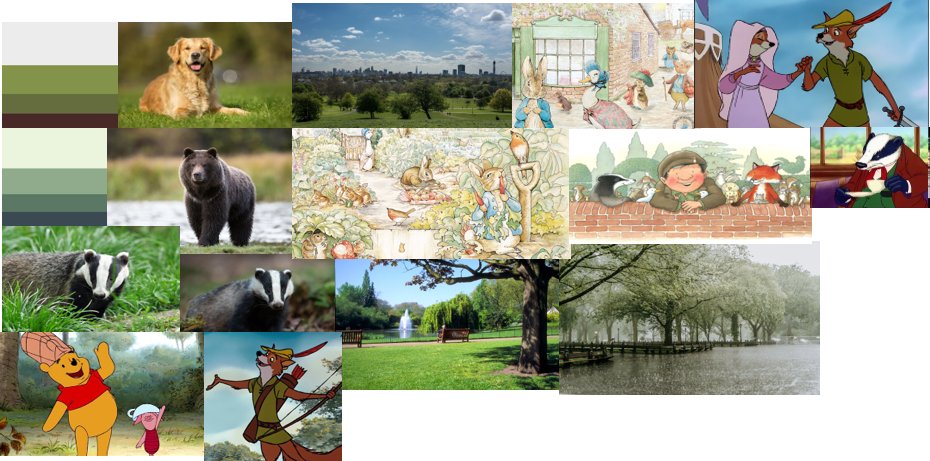
    Unfinished moodboard of my ideas.

    For some reason, I thought it would be wise to brainstorm animation ideas based on my moodboard before getting the audio. But after discussing it with Jess, I realised I was getting too ahead of myself and needed to wait until I had my audio before planning anything.

    We needed our 10-15 second audio by Wednesday, so I originally thought of asking my parents about their respective experiences moving to London back in 2003, and how much London has changed since then. However, I stuck with a different idea, which was to ask my schoolfriends about their own experiences over video call. The questions I had planned were:

    • What’s your impression of London?
    • What’s your favourite place in/part of London?
    • What has been your craziest experience in London?
    • How do you feel commuting to London?
    • What don’t you like about London?
    • 3 things that come to mind when you think about London and why?

    One of my friends couldn’t attend the call, but I was able to talk to my other friend, and on Tuesday we spoke about London for 40 minutes. From this, I got a snippet of audio that I felt was extremely suitable for this project:

    Wednesday (18/02/26):

    On Wednesday, we had to present our audios. Using CapCut, I prolonged the pauses as I felt they were too short, so the audio ended up being almost 15 seconds.

    We learned about different types of narrative structures, which included learning about structures such as linear and fractured, and types of conflict like Man vs Man and Man vs Society. We also learned about narrative building, and how to create a plot using a platform and a tilt. The platform is the foundation for the story, and enables us to answer questions about each character and what they’re doing + how they’re feeling. The tilt is the unexpected change that often occurs in a story.

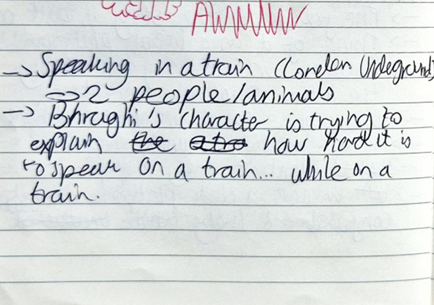
    Afterwards, we learned about beat-sheets, which are a list of key plot points (beats) that drive the narrative and will be used to help visualise our storyboards. We then had 10 minutes to identify the beats in our audio, which startled me as I didn’t have any ideas ton begin with, and was hoping to get more time to think about it. Jess also suggested that we do quick “sprints”, AKA write as many ideas as possible with a timed limit, thinking about questions like:

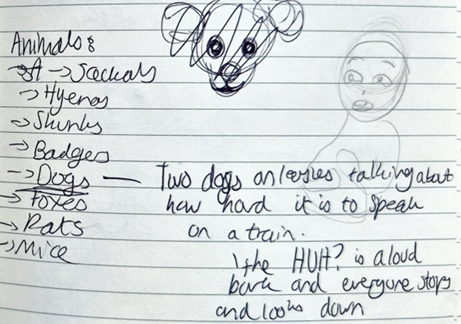
    • Which animals come to mind? (I wanted to animate animals rather than humans, I didn’t feel comfortable animating the latter at the time)
    • Which settings come to mind?
    • Which premise comes to mind? etc.

    The outcome of the quick sprints are shown below:
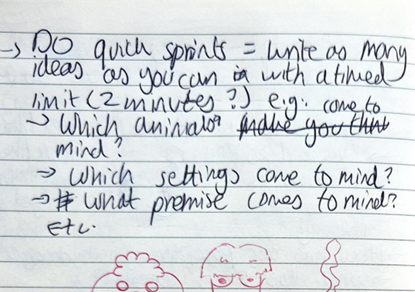
    This helped me brainstorm ideas clearer, and through this I formulated a platform idea.

    • Platform: Two dogs on a train, one of the dogs is ranting about how they can’t hear anything on the train because it’s so loud.
    • Tilt: The dog recounts her reaction to not being able to hear being like “HUH?!” and she shouts so loud, everyone turns to stare at the dogs.

    Lastly, we learned about storyboards and composition, with most of the content recapping what we learned in the Animatics rotation in Autumn. For Friday, we had to complete our beat-sheet and create a storyboard from it. I was dreading making a storyboard as I’m not good at it, and I usually go straight to making an animatic.

    When I got home, I made the beat-sheet, which took a while as I wasn’t sure what to add. To help, I used myself as reference and thought of ways to make the character acting as expressive and realistic (as realistic as a dog speaking can be) as possible, and wrote down each of Yappie’s actions as a beat.

    1. YAPPIE sits comfortably on her owner’s lap. Her tail wags (consistent throughout animation)
    2. YAPPIE opens her mouth. (“You know when the”)
    3. YAPPIE leans forward and lift her paw up, then looks up (“Trains like”)
    4. YAPPIE rises on her hind legs and lifts both paws up (“Screech like”)
    5. YAPPIE flaps her paws while swaying back and forth (“F*cking pterodactyls”)
    6. YAPPIE sits back down (her tail wags slower, as if unsure). She turns head to the other side, scrunching her paw up in a thinking pose (“Like…”)
    7. YAPPIE’s eyes dart to SCHNORKLE, and a smile slowly blooms on her face.
    8. YAPPIE turns back (ears flap as she moves) and she points at SCHNORKLE (“So you can”)
    9. YAPPIE stamps her paw down and partially stretches towards SCHNORKLE (“Barely”)
    10. YAPPIE fully stretches, basically in SCHNORKLE’s face at this point with her paws still firmly planted in her owner’s lap, and her eye twitches. (“HEAR”)
    11. YAPPIE moves back (“You’re like”)
    12. YAPPIE’s head tilts up and she barks, wearing a comical, derpy expression (“HUH?!”)
    13. YAPPIE points at SCHNORKLE (same frame as 8) (“So”)
    14. YAPPIE pushes up into her owner’s arm (“You just”)
    15. YAPPIE nods with the same expression as in 12 (“Nod”)
    16. YAPPIE nods normally (“And you’re like nodding, and you don’t understand a thing your”)
    17. YAPPIE gets pushed down by her owner, and looks annoyed at the action (“Friend says when they’re”)
    18. YAPPIE glances at her owner before smiling and continuing with her conversation (“Talking to you.”)

    However, I didn’t make the storyboard for Friday as I was unable to visualise anything without knowing what the character designs looked like.

    Friday (20/02/26):

    We learned about character design during this lesson, although most of what was taught was a recap of elements from Breaking Character. However, the activity was different, and we had to design to apply our knowledge of shape and structure. We then had to create character and expression sheets out of design characters out of inanimate objects . I found this activity challenging and was unable to visualise characters in such little time, and felt I didn’t execute their designs the way I wanted to.

    Afterwards, we were given examples of other artists’ work in regards to what the aesthetics of our respective animations could be. I really liked Beatrice Blue and Tonko House’s work as at the time I believed they fit the best with my aims for the project aesthetic-wise.

    We then learned how to create a construction sheet, and for our homework, we needed to come up with designs for our characters and create construction sheets and character turnarounds for them.

    When I got home, I immediately started devising initial designs for both characters. Inspired by the quick sprints exercise, I implemented it into the designs to help me brainstorm their appearances. I intended to push the boundaries of my creations, and everytime I’d draw something I’d then devise components to exaggerate. The artstyle was intended to be reminiscent of Disney and Golden Age Cartoons, but also of dog memes I frequently find on Pinterest. Since I wanted both characters to be lapdogs, I came up with a variety of breeds that could fit them respectively. I ended up choosing dachshund and pug, and decided each dog would have completely contrasting personalities in accordance with the “Unstoppable Force vs Immovable Object” theory. This was also heavily inspired by my own dogs, who are both polar opposites. In this case, the dachshund is the character speaking, and I chose this breed not due to its personality but because of its appearance. I felt it would have enough energy and squash + stretch to emulate the energetic nature of the character. Its long body could easily be contorted and elongated like a slinky to show how bouncy the dog is and how it is unable to stay still. Its temperament did help solidify my breed of choice, as dachshunds are known to be vocal and full of energy.
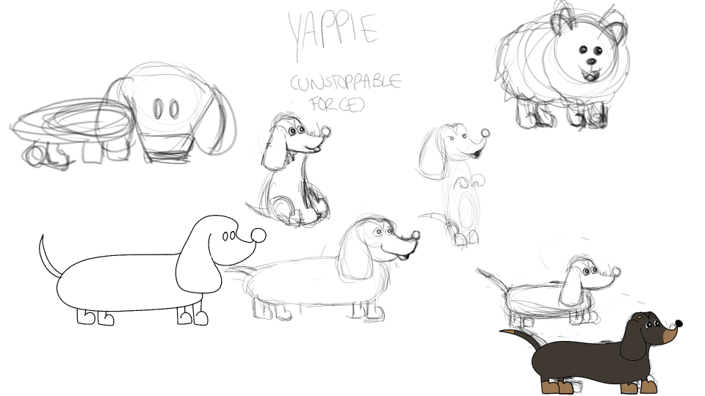
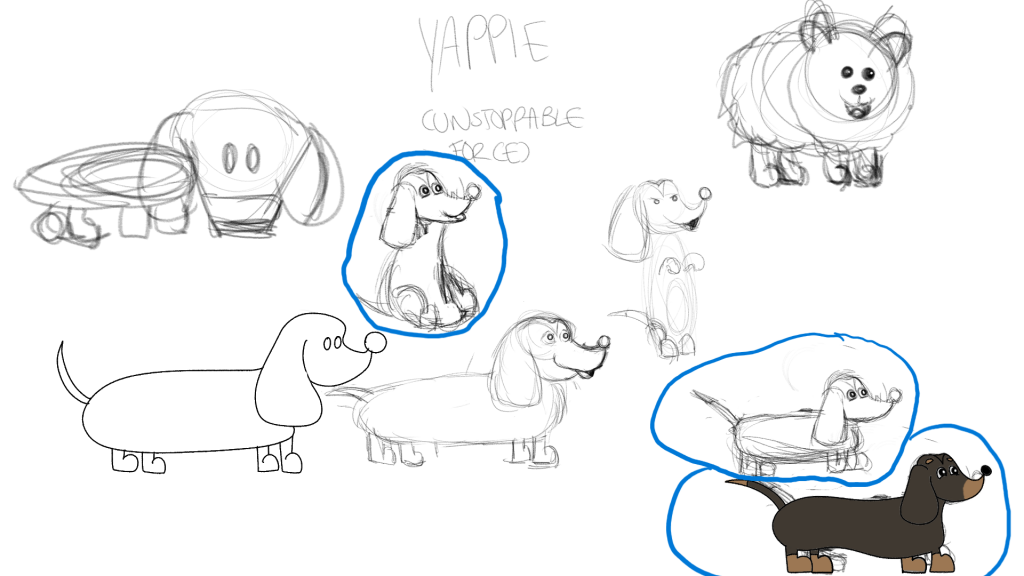
    “Yappie’s” original designs. The drawings circled are what I decided on using in the animatic (until I changed my mind during the production process).

    On the other hand, I chose a pug for the lazier character as I have always perceived them as such (despite their personalities actually being more akin to dachshunds), and often see them as companions for older people. Moreover, pugs seem to have limited mobility, and I really wanted to outwardly contrast the 2 dogs to make their dynamic more interesting. I worked on the pug’s design before the dachshund’s as I had a better idea of what the former would look like.
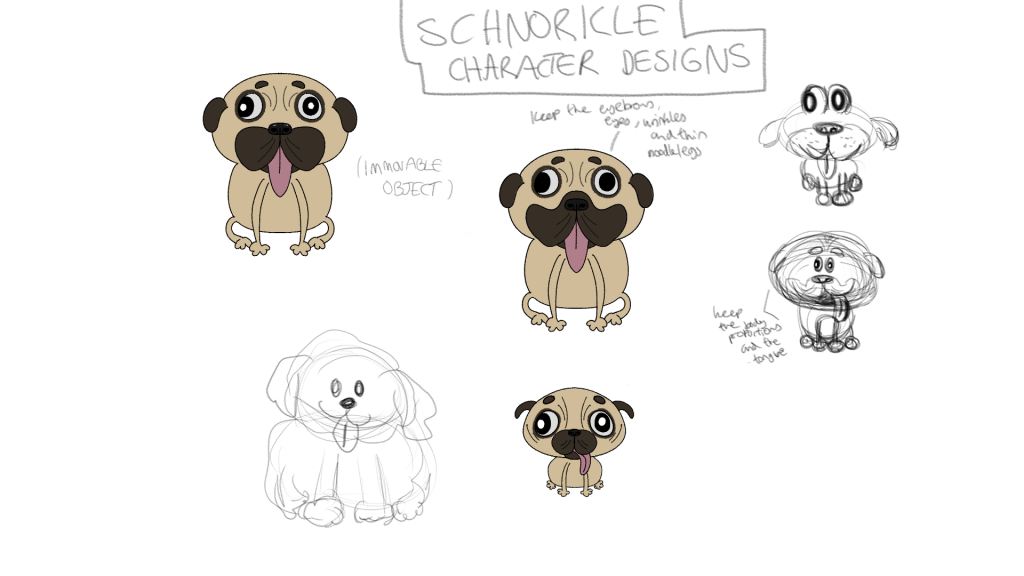
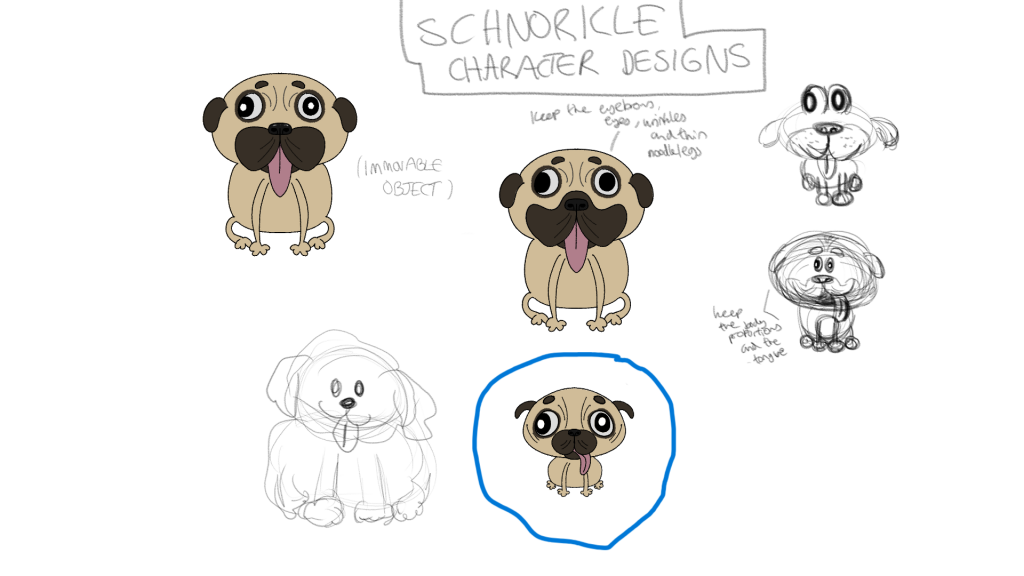
    “Schnorkle’s” original designs. The drawing circled is what I decided on.

    From the initial designs, I made the storyboard in Clip Studio Paint (see Storyboard in PDF) and then got started on my animatic. I didn’t stick close to the designs when storyboarding or animating, instead making everything as rough as possible because I didn’t want to spend most of my time on it. This was the first draft of my animatic (taken directly from the storyboard with more frames added in between):
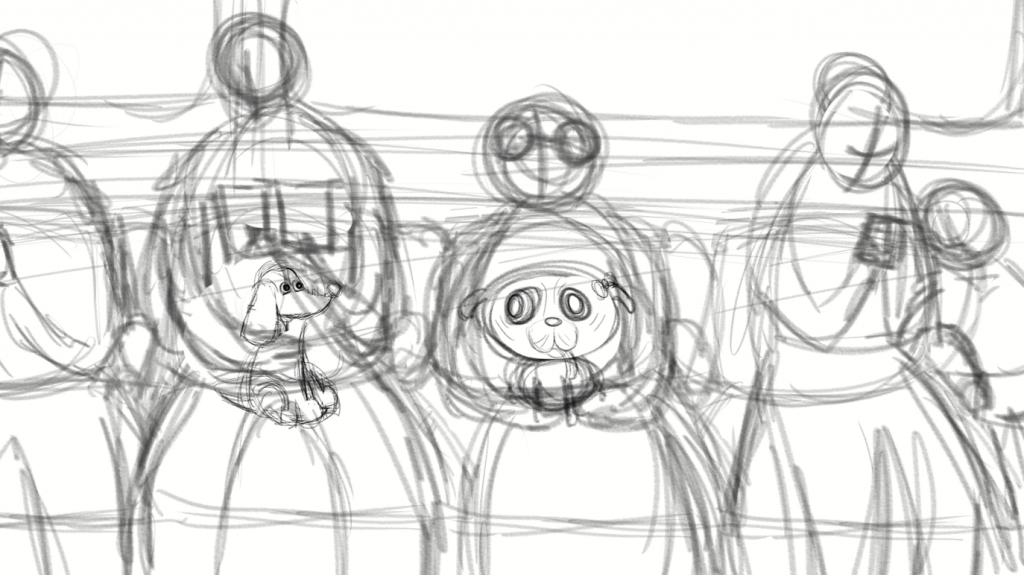
    Animatic first draft. Click the photo above to be redirected to Padlet.

    This was the moodboard I created from the plot idea and character designs:
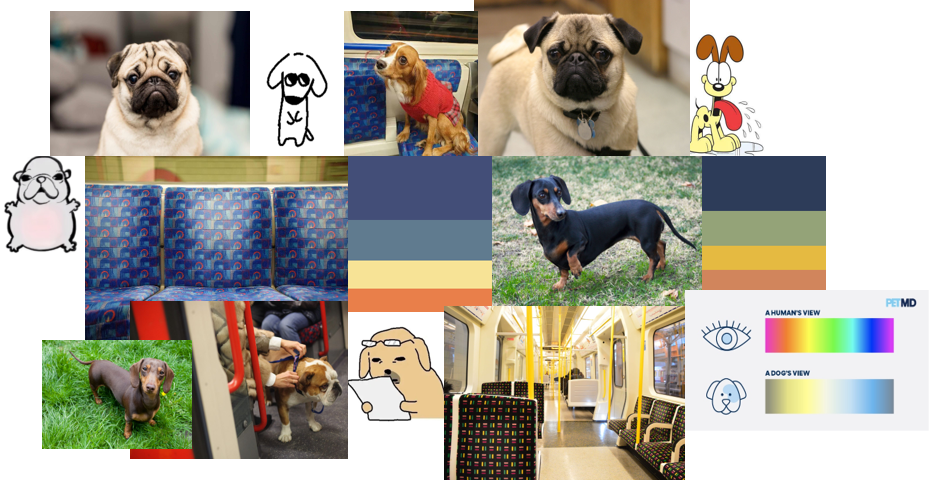
    New moodboard after obtaining audio.

  • OUT OF YOUR HEAD — POST-PRODUCTION


    Please note: every video below is also on Padlet.

    I have split the content from Out of your Head into 3 sections to show the production pipeline and the chronology of how we worked throughout the project:

    WEEK 10:

    Our initial plan for post-production was for one of our groupmates to finish compositing before sending the file to me to add sound effects to, then sending it back to her to add voice acting. However, the last few days of the project were an unexpected turn of events. She decided to back away from the project, which threw everything off balance since she was in charge of editing and compositing. We then had to scramble to find a way to finish the project, and I was put in charge of editing the clips together alongside sound design.

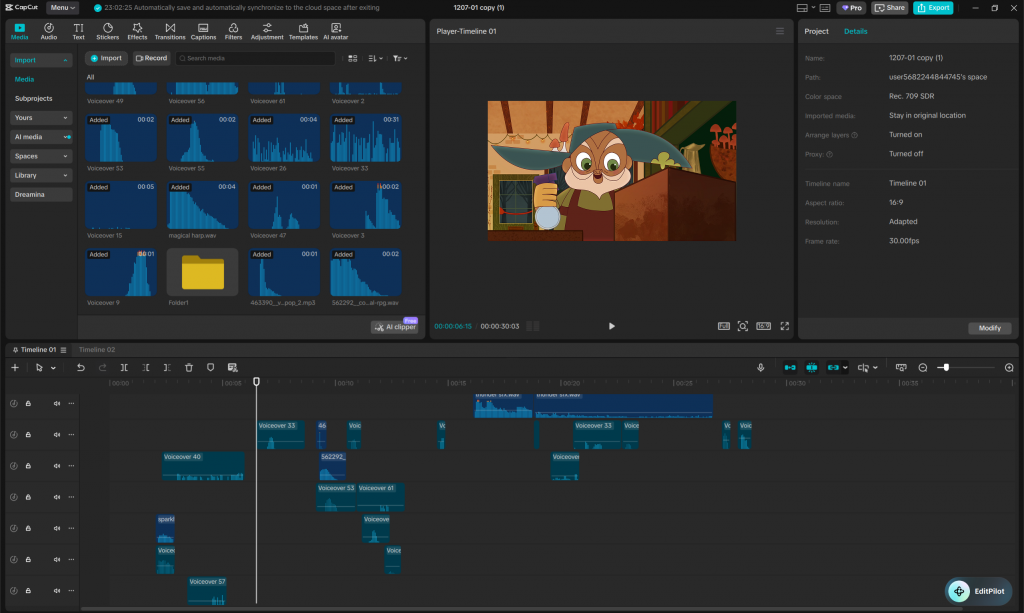
    I used CapCut, the same program that I initially used to add sound to the animatic.

    My workspace on CapCut.

    Firstly, I duplicated the file with the animatic and sound effects, as we decided to reuse the same SFX (including voice acting). I then deleted the original clip and replaced it with everyone’s scenes in chronological order. Afterwards, I moved sounds around to match the timing (as a lot had changed since the animatic), then added more sound effects using Foley and effects from free-sound. Lastly, I voice acted for Phool once again, adding ad-libs such as a gasp or a grunt to scenes that required them. I ended up wrapping up post-production and submitting the final animation the day after.

    During this rather stressful period I frequently contacted the rest of the group and updated them on my progress with post-production, with them giving their input and feedback almost immediately. The fact that we all collaborated as a team helped us deliver the animation on time despite the challenges we faced.

    FINAL THOUGHTS:

    There is a lot of things that I would like to do differently next for the next project. The sound could have been more refined, and although this was largely a result of the issues we had the last couple of days before the film was due, this is still something I would like to improve upon for next time. Additionally, I would like to do rough animation alongside lineart and colour, and I wasn’t able to for this project (apart from for scene 10) due to going on holiday near the end of the Christmas break. I also want to improve upon my backgrounds and and learn compositing since both skills would come in handy in the future.

    In retrospect, the issue with clarity was a direct result of not having a producer, only a director. Oftentimes miscommunication derailed parts of the project and sometimes our roles and deadlines weren’t communicated properly. Therefore, I would like the opportunity to take on the producer role in later projects. While I know it would be a challenging experience, I would also love to learn a variety of skills related to teamwork and organisation that would greatly benefit me going forward. Next time, I would like to implement the following solutions to hopefully help in the production process:

    • Create a schedule that clearly outlines the roles that everyone has been assigned to, whether they have completed their roles and when each deadline is using resources such as a Gantt chart.
    • Provide information to group members if something hasn’t been explained well and clear up any miscommunication that arises to ensure everyone is on the same page, and we can work as efficiently as possible without any further issues.
    • If not properly established in pre-production, animators should clearly communicate with each other in terms of whether there are any inconsistencies that may affect the entire animation, for instance shot composition, key details in character designs that may have been missed, possible props to be animated, colour palettes etc.
    • A group chat should be made to send regular updates of work in progress so that people can help each other in time and we can all collaborate instead of relying on one person to give advice once we’ve finished everything. 

    Overall, I think our group did a fantastic job given the circumstances, and we executed almost every idea that we previously brainstormed. Everyone worked extremely hard, and the sheer effort and determination definitely paid off in the end. I am so proud of our group and how far we’ve come since the beginning of this project.


  • OUT OF YOUR HEAD — PRODUCTION


    Please note: every video below is also on Padlet.

    I have split the content from Out of your Head into 3 sections to show the production pipeline and the chronology of how we worked throughout the project:

    WEEKS 4-10: (15/12/25-30/01/26)

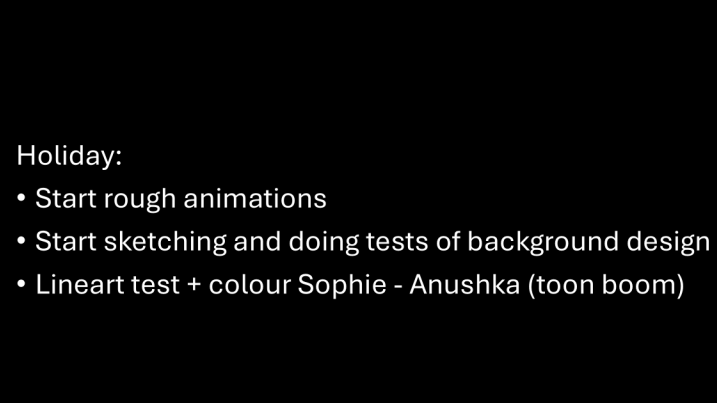
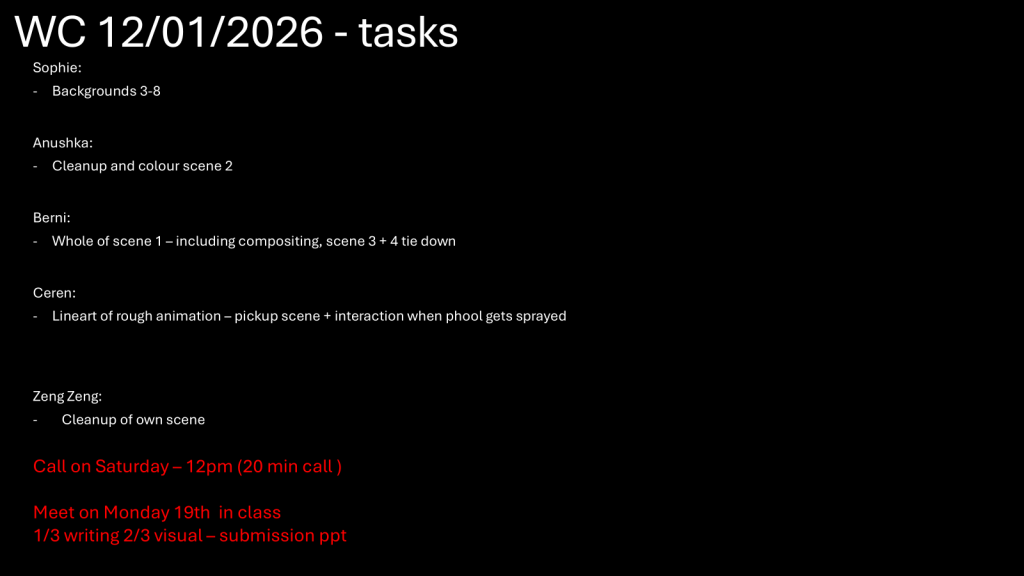
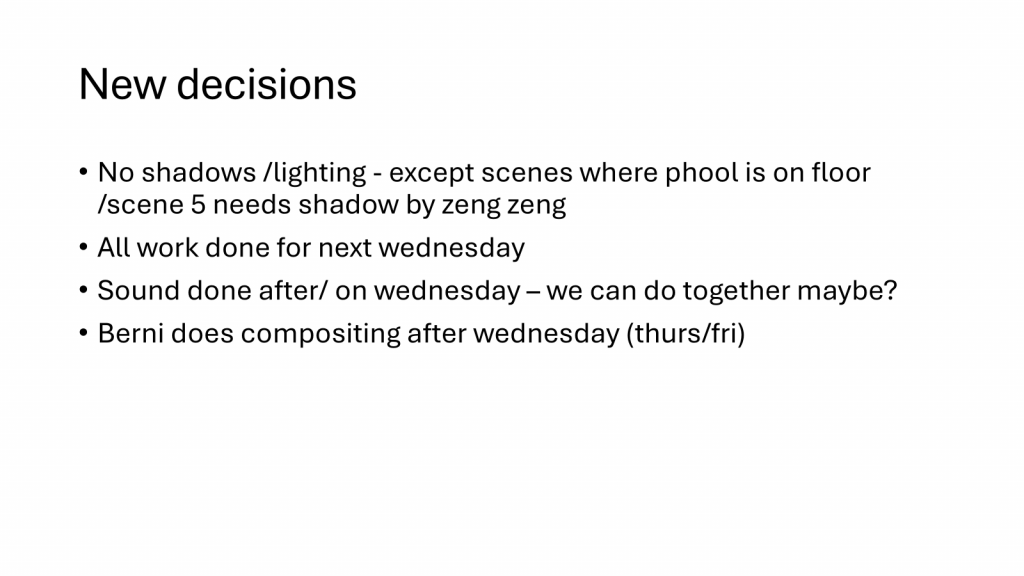
    Planning for the production side of the project began just before the holidays, and we created a task-list of what to do during Christmas break as shown below:

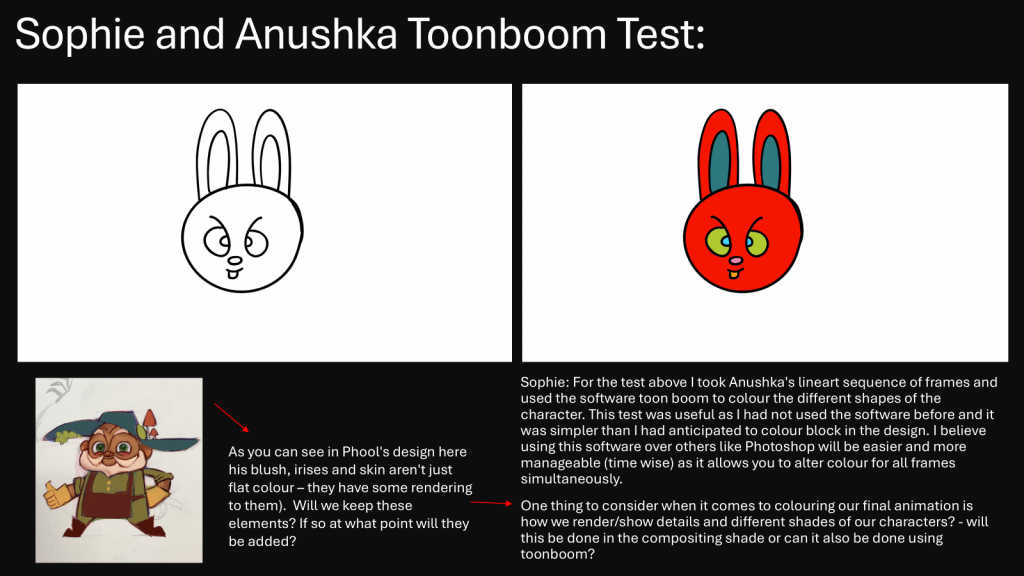
    During the holidays, I downloaded ToonBoom Harmony (the software most of us would use for lineart) and watched a tutorial on how to use it, before animating a boil of the character Leebit from the K-Pop franchise SKZOO to send to Sophie to colour.

    Lineart test by me.

    Colour test by Sophie.

    Initially, we had decided that I would lineart and Sophie would colour scenes, however since Sophie had a lot to cover with backgrounds (she designed all of them!) I ended up taking on both lineart and colour (which was honestly more efficient in the long run).

    After returning from my holiday, I felt bad as everyone in my group was working so hard, and I wanted to take some of the weight from them and help. Therefore, I got started with animating scene 2 on Toon Boom Harmony.

    Our tasks during the week we returned to university.

    Firstly, I began drawing keyframes (this took me around 2 days to complete), as shown below:

    Scene 2 Keyframes. PLEASE NOTE: The video is pixelated and I don’t know how to fix it.

    After drawing in the keyframes, I finished in-betweens (which took me another day). I then used the colour palette that Berni collated from her animation of scene 1 and applied it to my own scene (both Phool and the box). Afterwards, I sent the animation to Berni for compositing.

    Scene 2 lineart and colour.

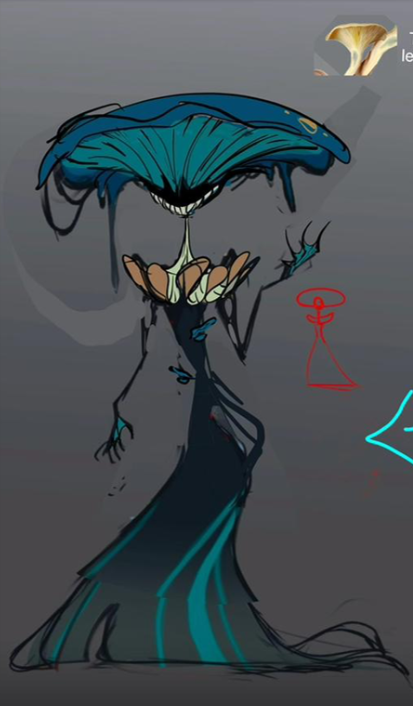
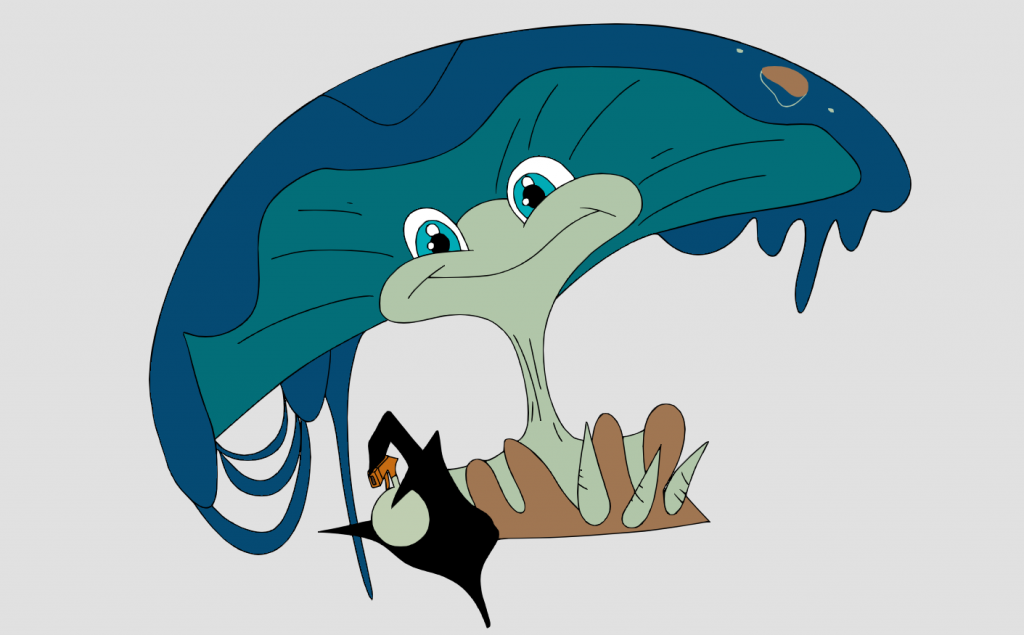
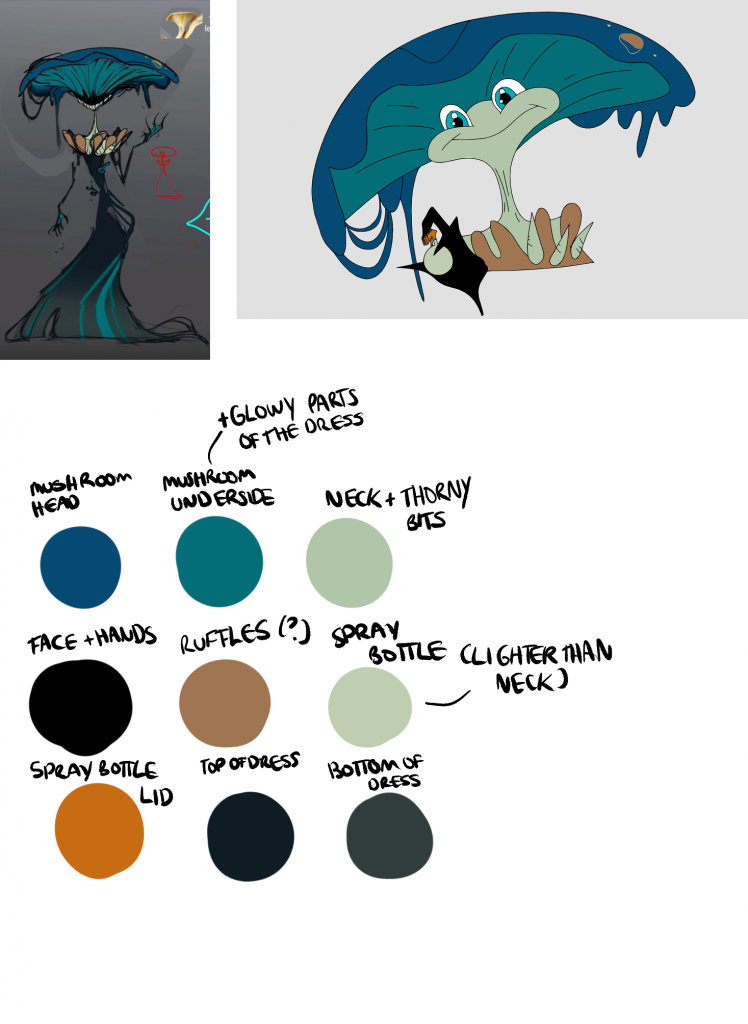
    After animating scene 2, I was also given the task to draw scene 10 (rough, lineart and colour). Since we hadn’t actually established the creature’s colour palette, I was told to use the original palette that Zeng Zeng made for the ‘bargain deal’ idea, as shown below:

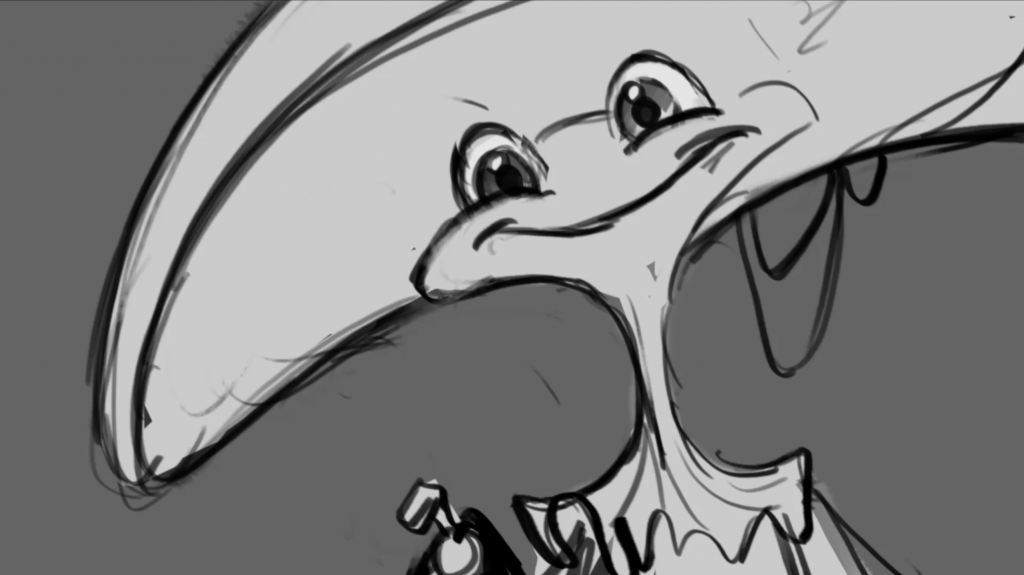
    I began by using the animatic as reference and traced rough outlines of the creature using the same brush size I used for Phool (not realising I should have increased the size since she’s a much larger creature than he is and a thinner brush line would make her look disproportionate).

    Scene 10 from the animatic (a still, did not have to be animated)

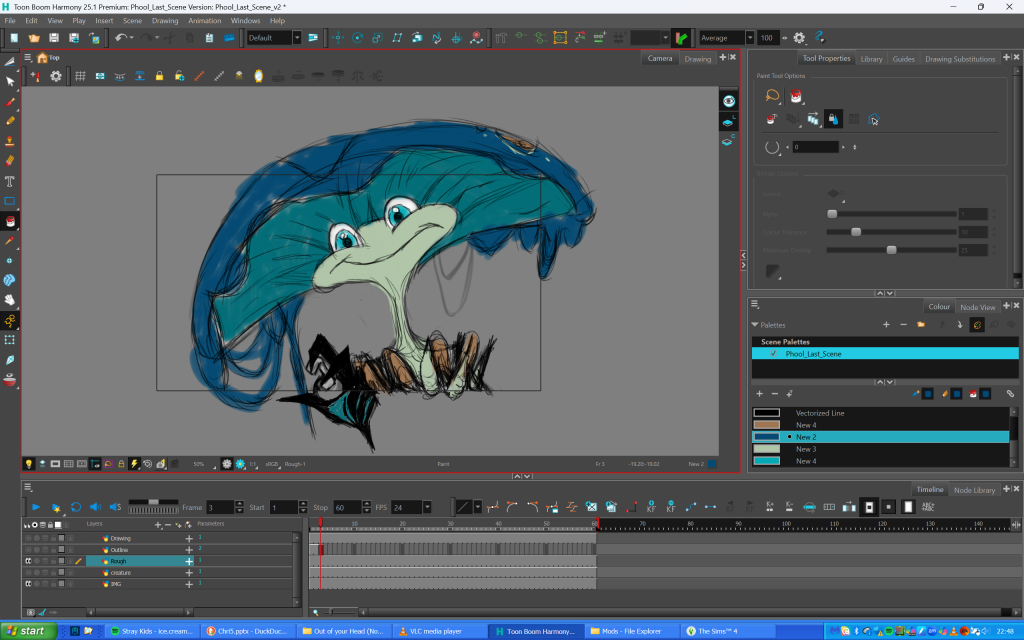
    Rough sketch of the creature with colour swatched in as a test.

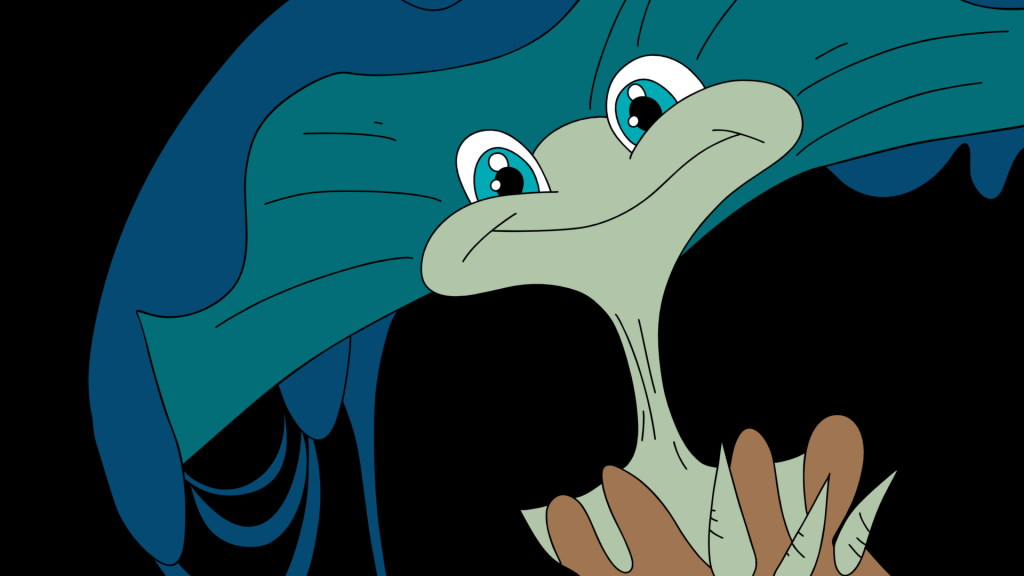
    Scene 10 coloured

    Later on, while comparing our progress with the rest of the group, we realised that there were some inconsistencies with our animations as we relied on the animatic as references (we didn’t have anything else to go by). One of the main ones was that the hand used to spray Phool was meant to be the creature’s right, not her left. I tried to alter it on ToonBoom by flipping the hand, but it ended up looking wrong, and after trying to sketch her right hand for far too long I gave up and removed her hand entirely.

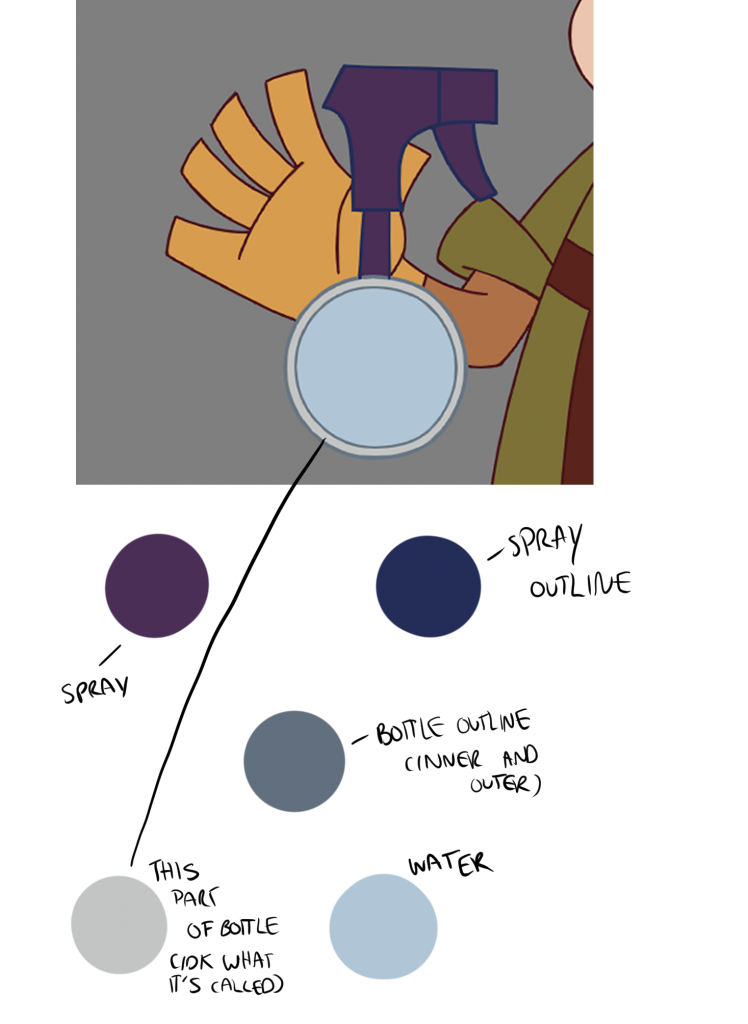
    Moreover, we didn’t know what the colour of the spray bottle was, therefore in her scene Zeng Zeng coloured it with a purple nozzle and water inside (light blue). We really liked the design, but Berni wanted the colour changed to reflect the colour palette of the background more, alongside removing the water as it would be more complicated to animate (which was definitely true). The rest of us didn’t agree with the former, and while Berni was adamant to have the colour changed, it didn’t feel significant enough to warrant one, especially since there were already so many more serious inconsistencies such as the hand placement that I discussed above, and we still had our animations to finish. Therefore, we reached a compromise, and retained most of Zeng Zeng’s design while removing the water.

    This is what scene 10 looked like after the changes:

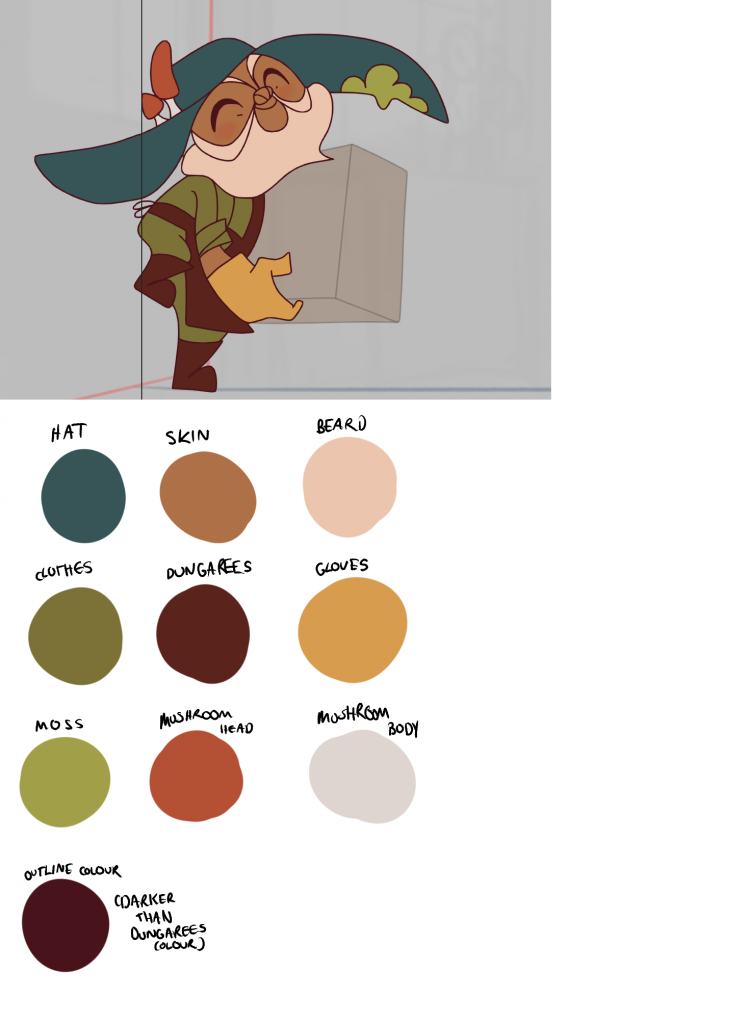
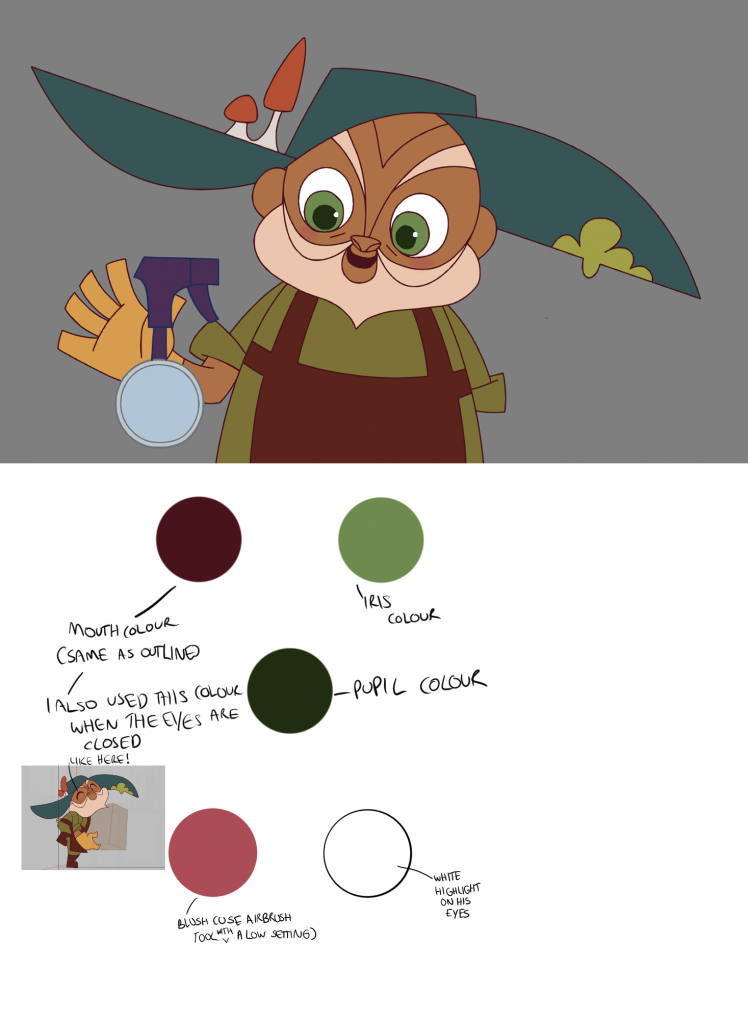
    Since a cohesive colour palette was not established, I used my scenes to create one for the group to use. I then updated it later on with features from my later scenes that I wasn’t able to add before, while also adding the new colour palette of the spray bottle.

    Original colour palettes for Phool and the creature

    Updated colour palette for Phool, including the new design for the spray bottle

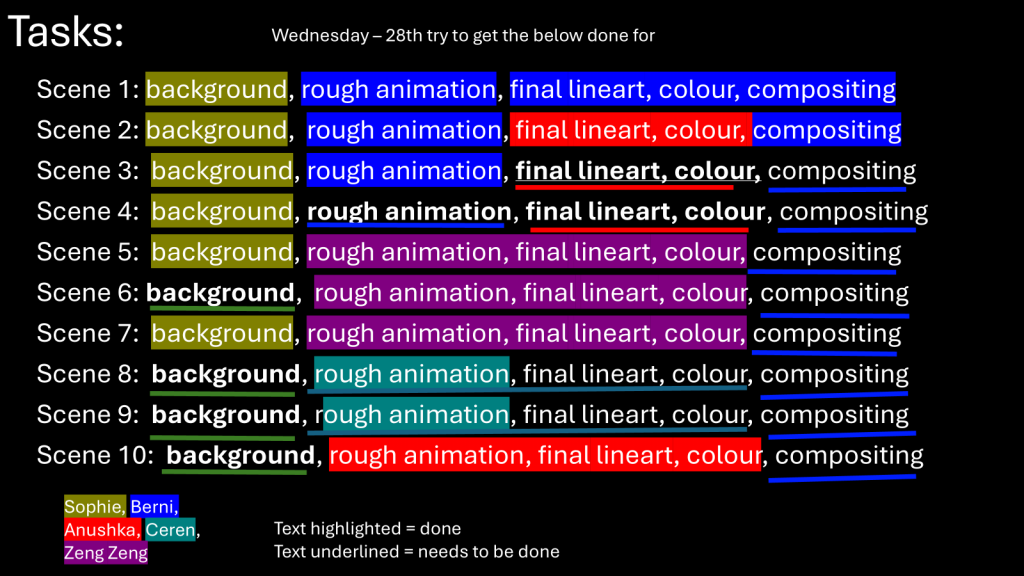
    We did encounter a few instances of miscommunication within our group, which was perfectly normal. However, it escalated and essentially exploded a few weeks into the new term, which was necessary yet highly inconvenient. To overcome this, Jess suggested we create a chart where we allocate tasks to each person to be completed by a certain deadline (in our case Wednesday 28th, which was the week after by that point), and colour-code whether the person has finished their task or not. We created an equivalent below:

    As you can see above, I still had scenes 3 and 4 left to lineart and colour before sending them to Berni for compositing. I was in the process of completing scene 3 at the time, and had to animate each component incrementally before moving onto the next one, hence the various versions shown below. I began with animating the hat since it was the element that I felt the most worried about, so by animating it (alongside the small mushrooms and moss on the hat) first I saved myself a lot of hassle later on.

    Scene 3 iteration 1: hat

    Scene 3 iteration 2: body

    Scene 3 iteration 3: hands and spray

    Scene 3 iteration 4: face

    Scene 3 iteration 5: colour

    Scene 3 iteration 6: blush and highlights

    Scene 3 iteration 7: mushroom

    Scene 3 iteration 8: water

    In regards to scene 3, I was told that if it ever got too much (since I had to take my time with the scene in case inconsistencies arise), someone else could animate scene 4 in my place. It took me almost a week and a half to animate scene 3 due to its sheer intensity and constantly checking for and replacing errors, Therefore, I did end up asking someone if they could animate scene 4 instead.

    REFLECTION:

    In terms of software, ToonBoom took time to get accustomed to as I was so used to Clip Studio Paint as my preferred program for animation. While I did get used to it after a short while and its user interface became much easier to navigate, I did come across a complication when animating the second scene. For some reason, I had two save files of the same animation, yet only one of them was up to date. Therefore, I clicked ‘save’ and closed both windows before reopening them and checking the file once more. But for some reason, the outdated version was saved instead! I felt extremely panicked because I had finished all of the lineart of Phool by that point, and I genuinely felt as though my life’s work just went down the drain (dramatic I know). Thankfully Berni was there to help and told me that ToonBoom never necessarily deletes work and there’s always a backup somewhere. I ended up finding the lost frames in a backup file and imported them into the scene using the drawing substitutions tab.

    Miscommunication became a huge issue in this stage, as whilst we were working on our respective animations, we did need clarity in order to keep everything as consistent as possible. Since we slightly underprepared in the pre-production process, we underestimated just how disruptive this would become to our workload. This was especially in regards to not creating a proper character, expression or height comparison sheet for both Phool and the creature since we assumed we didn’t need them. This impacted my groupmates who merely had the animatic to rely on and were drawing the rough animations from scratch. Therefore when they presented their progress with their respective animations, our groupmate pointed out many details that we never previously established. This led to an array of misunderstandings and a lot of friction within the group that continued despite attempts to resolve it and communicate better. 

    In general, the production process was exhausting yet highly rewarding. It was good to work on our respective animations in our own time. Whilst lineart was challenging, I learnt so much about how to draw faster and more efficiently, whilst retaining everything laid out in the rough animation. At times I did struggle with consistency, as in scene 2 I relied heavily on the rough animation and ended up drawing the eyebrows with different sizes in each frame! Moreover, I do highly regret not finishing scene 4 by myself, as everyone was burnt out and I should not have used it as an excuse to ask someone else to complete it instead. Next time, I want to handle my workload better and find ways to reduce burnout without procrastinating or offloading my own tasks onto others that are just trying to finish their own. Despite this, I believe I did a good job and was able to replicate the artstyle of the animation to the best of my ability.