Category: Breaking Character

  • BREAKING CHARACTER — 10/10/25


    Today was finally presentation and feedback day! We ended up sharing our work onto Padlet and gave each other feedback from there, which was honestly a relief because I’m always so nervous when public speaking! However, at some point my brain did become saturated enough to the point that I couldn’t really think of anything else to comment, and I felt bad about it because everyone did so well and l wanted to give their work my full attention.

    The feedback I got was overwhelmingly positive, and I was able to learn a lot from how everyone viewed my work and what they wanted to see more of. Feedback that I received included (paraphrasing):

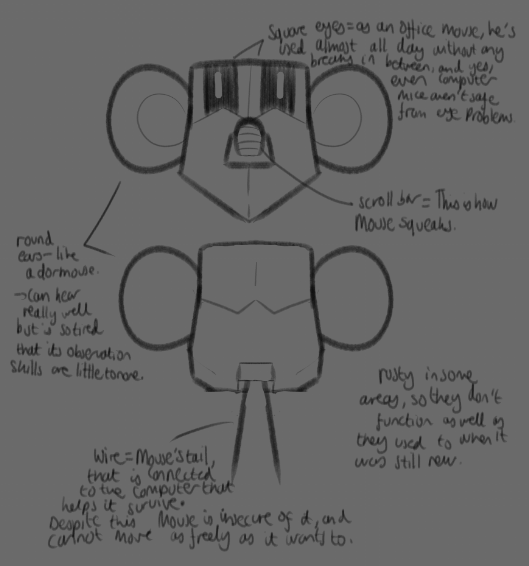
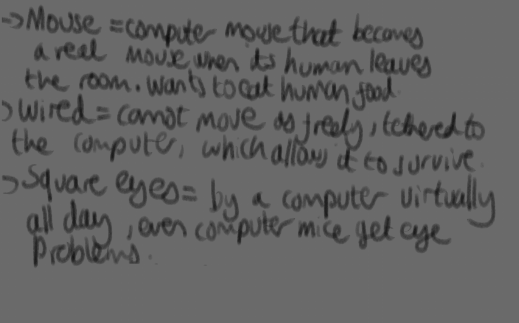
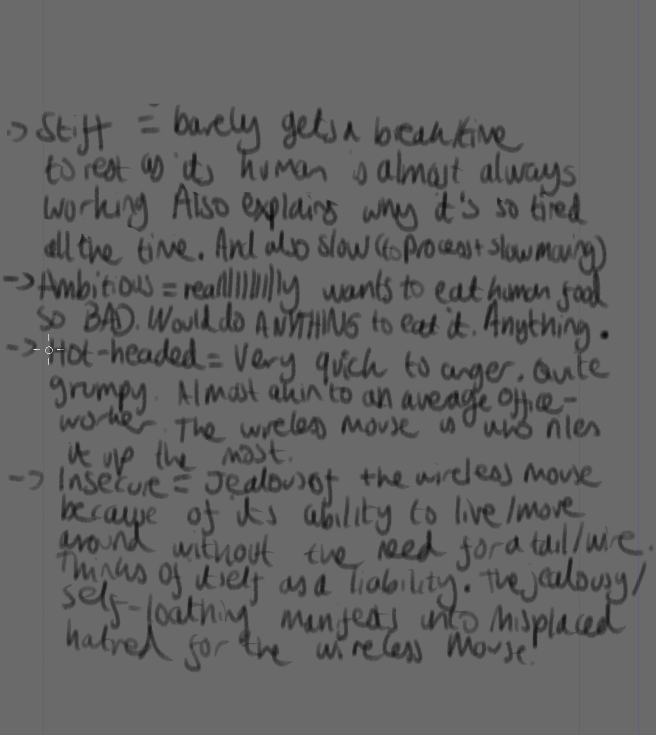
    • Notes for design are extremely detailed, a lot of thought was put into character design and storytelling.
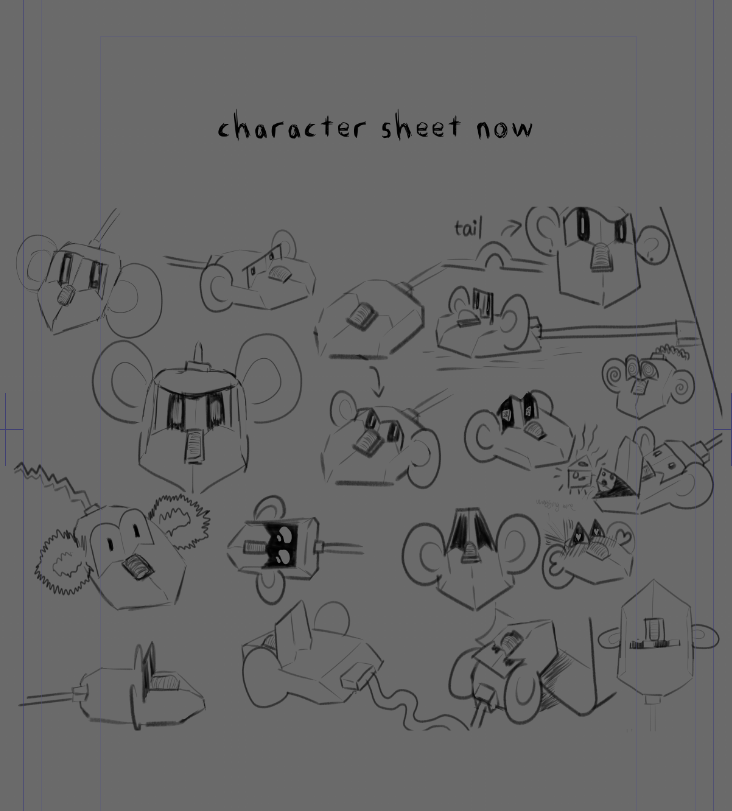
    • Mouse is very expressive.
    • Experiment with different colours to see how it could fit within the setting.
    • Seems like a very comedic character due to his appearance and qualities.
    • Consider how he moves and interacts with the environment -> since his tail is a big part of his character, find more ways to have him use it to interact with the environment without being unplugged.
    • Consider his personal development: how his inferiority complex evolved, whether he goes on a journey to recognise his self-worth, etc.
    • Consider: Since Wireless Mouse was mentioned, what would he look like in contrast with Mouse? Could Mouse get crumbs in between his parts when eating human food? How does Mouse transform when humans aren’t around? Would Mouse’s tail be visible from a front perspective?
    • Changing the eyes to square works well.
    • Change the background to white to make sketches stand out.
    • The ‘disgusted’ facial expression appears more ‘annoyed’ + pleading doesn’t communicate as well as the other expressions.
    • Find more non-human animation references as examples?

    Overall, I think I definitely achieved the goal that I wrote at the beginning of the rotation, and created a character that was simple and stylistic, and that I was confident in sketching out quickly instead of taking my time to draw. However, I really wanted to also do a motion plan/character design for the Wireless Mouse, but I felt it would be better to prioritise Mouse (Wired Mouse) for this rotation and I could then explore the Wireless Mouse’s design in my free time. I’m excited to use the lessons I learned in this rotation and apply it to Making Character, where I’ll actually be animating Mouse properly for the first time!

    New version of final outcome with some of the feedback in mind.

  • BREAKING CHARACTER — 08/10/25


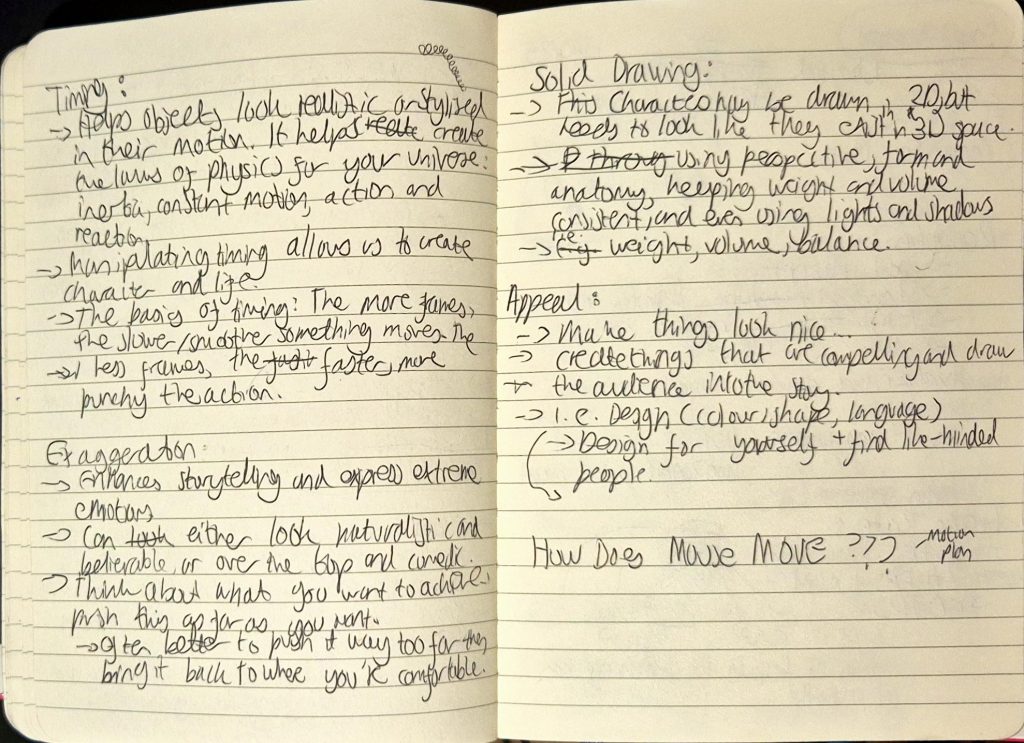
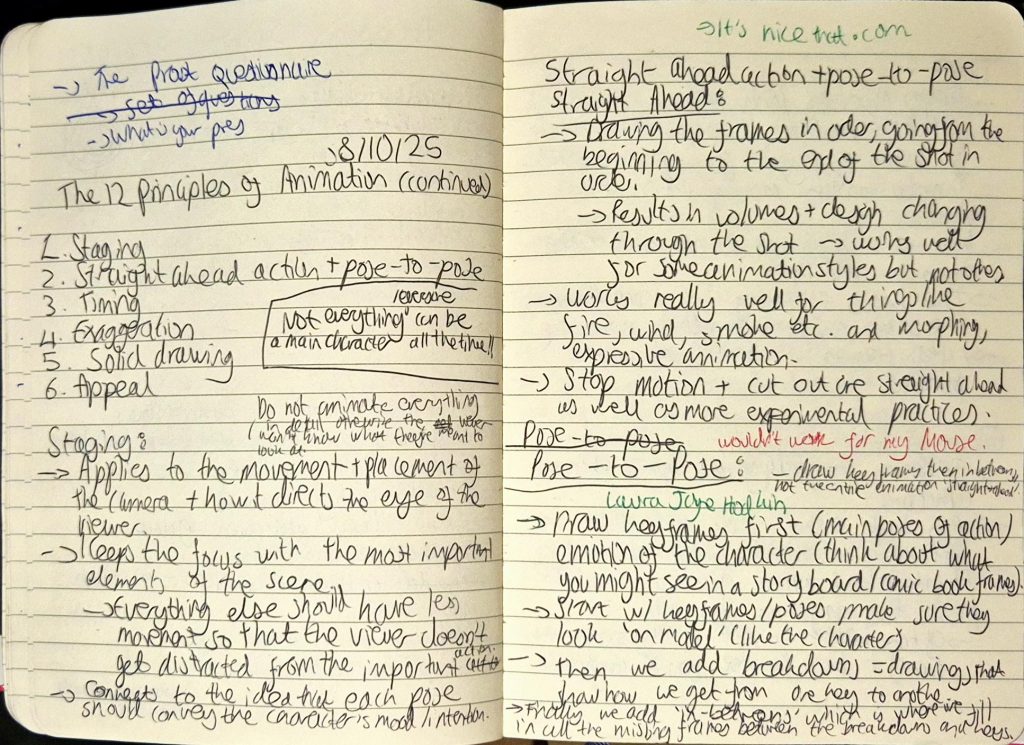
    We learned the last 6 principles of animation, which were:

    1. Staging: Applies to the placement and movement of the camera and how it engages the viewer, keeping the focus on key elements of a scene.
      • E.g. if showing a cafeteria, focus the main characters eating rather than the background characters moving around.
    2. Straight ahead/pose-to-pose:
      • Straight ahead: used in more experimental practices. Is the process of drawing each frame in order, which results in the volume of the object/character changing.
        • E.g. animating fire.
      • Pose-to-pose: used in character animation. Is the process of drawing the keyframes (main poses of action) first and making sure they look exactly like the character, before moving onto breakdowns and then in-betweens.
        • E.g. animating a human character.
    3. Timing: Helps objects look more realistic/stylised depending on what the intentions are with the animation. Linked with ease in/ease out to an extent, as it describes how more frames = slower/softer timing, less frames = faster/more abrupt timing.
    4. Exaggeration: Enhances storytelling and is used to express extreme emotions. Less exaggeration = more realism, more exaggeration = more stylised.
    5. Solid drawing: The idea that characters need to be drawn in 2D but appear as though they exist within a 3D space.
      • This involves using design techniques such as line, form, anatomy, volume, weight, light etc.
    6. Appeal: A character must be made to look compelling enough to draw the audience into the story.
      • This can be achieved through design (colour, shape, language etc.).

    My notes

    The activities we did to explain staging and exaggeration were really fun to participate in.

    For staging, Jess told us to get into large groups of 2 and create a tableau that we’d show to the other group and vice versa. These tableaus would allow us to see how we can use secondary actions to support the main action without being too distracting. Our group came up with a fight scene, with Berni and I fighting and everyone else watching and filming.

    For exaggeration, we had to individually come up with the loudest and most exaggerated yawn, and also the most subtle yawn that still looks like said action.

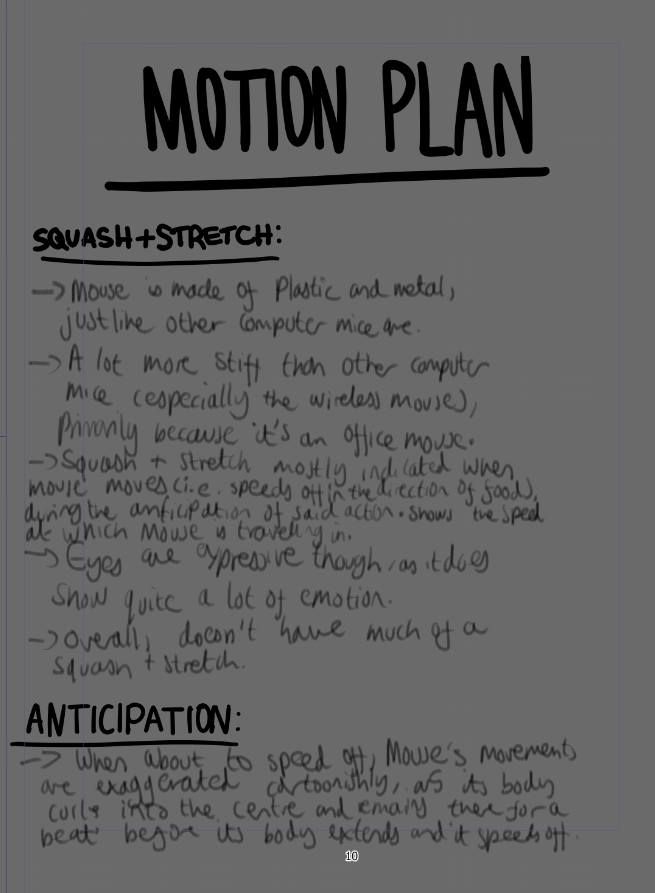
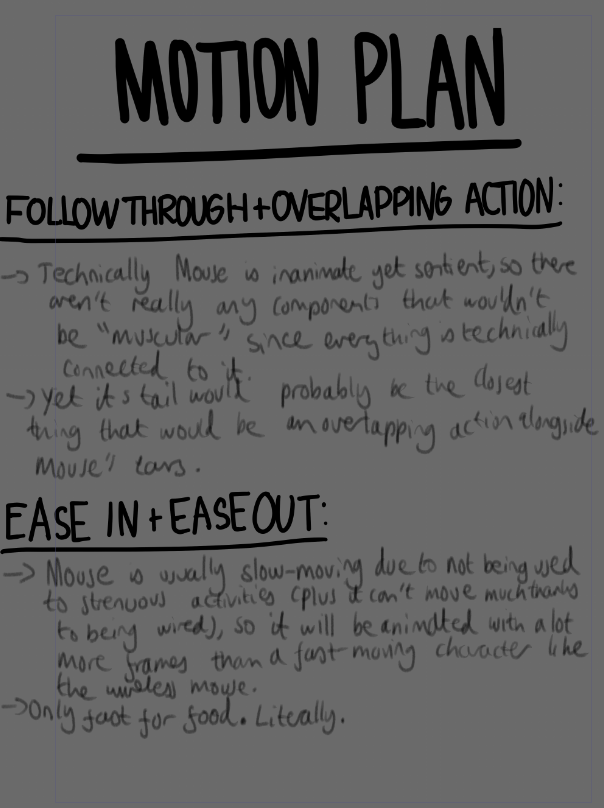
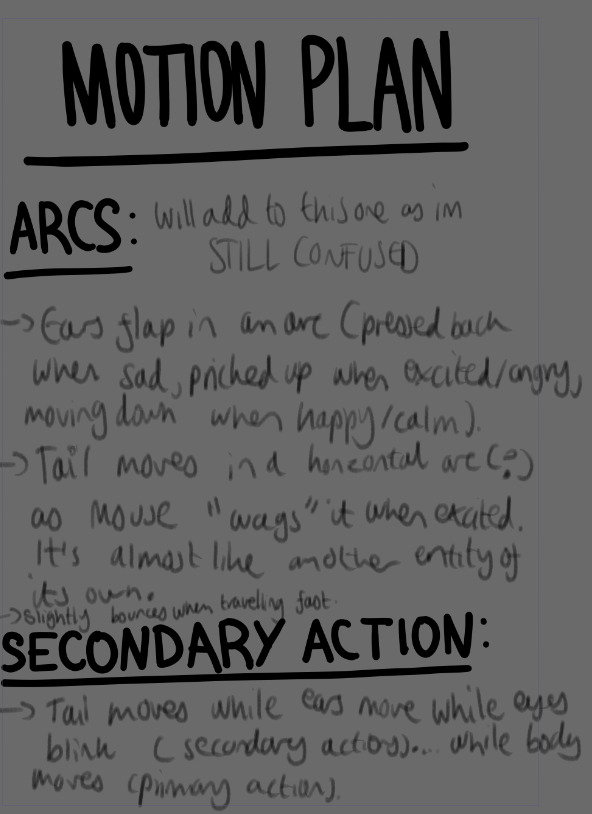
    Since the overall assignment (including the motion plan) involves creating a triptych from the original character experimentations that we did last week (alongside the character sheet, expression sheet and character turnarounds) I also asked Jess whether we could include additional information about our character’s personality and the original character designs I made alongside some physical characteristics, and she said we could. Therefore, on Thursday I finished my motion plan of Mouse, which is shown below:

    I didn’t end up writing notes for each principle because it was so difficult to think about how each one would be used in Mouse’s design and movements, and so I merely discussed 9 out of 12 of them, with visual evidence for squash and stretch and exaggeration.


  • BREAKING CHARACTER — 06/10/25


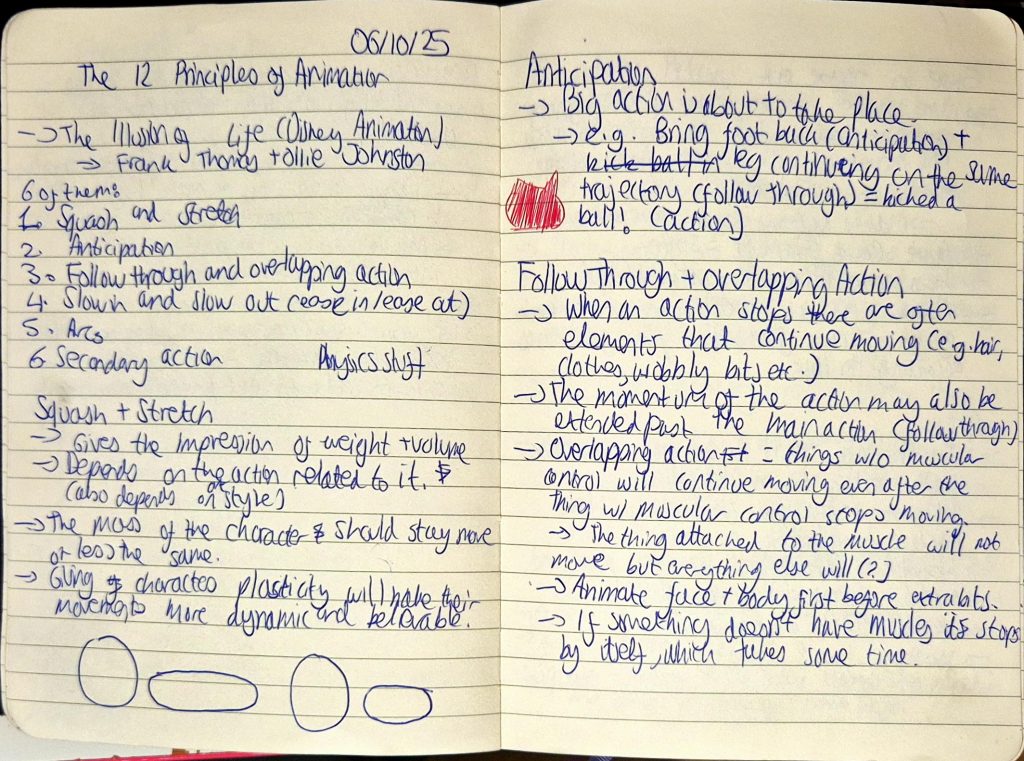
    On this day Jess taught us about 6 of the 12 principles of animation, and gave us examples + activities to do to show how they’re applied:

    1. Squash and Stretch: gives the impression of weight and volume (the more squash + stretch, the more plasticity the character has). The mass of the character must stay the same.
      • E.g. when a character jumps, they squash when they reach the point of contact, and stretch just before and after.
    1. Anticipation: The beat before a key action takes place.
      • E.g. when a character is kicking a ball into the goal, they would bring the foot back (anticipation) before leg continues onto the trajectory and then kicks the ball (action).
    2. Follow through + overlapping action:
      • Follow through: when an action stops there are elements (usually those that don’t have muscles but are still an extension of the action/character) that often continue moving after.
      • Overlapping action: when different parts of a character/object move at different times/rates.
      • Examples of both include hair and clothes.
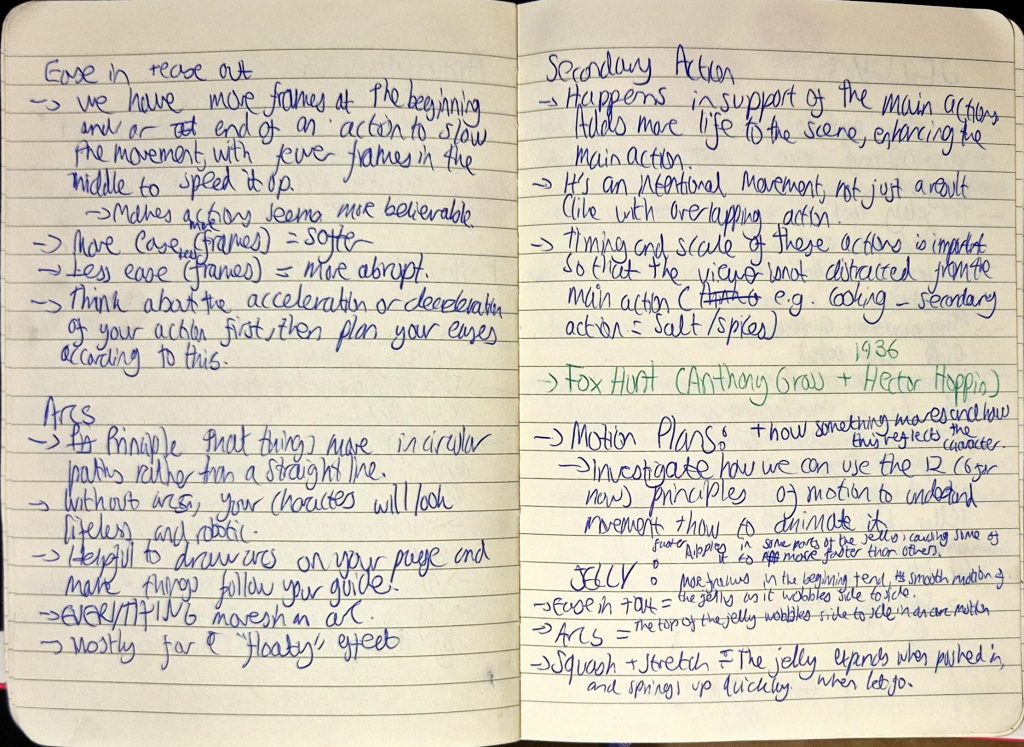
    3. Ease in/ease out
      • When there are more frames at the beginning/end of an action to decelerate the movement, and fewer frames in the middle to accelerate it (makes actions more believable).
      • More ease = for softer movement (e.g. scooching back, typical motor reactions)
      • Less ease = for abrupt movement (e.g. flinch, reflex reactions)
    4. Arcs (I dislike this principle so much)
      • Have every character move in a circular path rather than a straight, lifeless line. Used mostly for “floaty” effects.
      • For some reason, to me this principle is more difficult to describe or give an example for unless it’s the character very literally moving a part of their body in an arc shape. I don’t really know how I can apply this principle to everything.
    5. Secondary action
      • Not to be confused with follow through/overlapping action as it isn’t a part of the character at all. It is usually an entirely different object/character that moves in tandem with the main action/character, adding more life to a scene without detracting anything from it.
      • E.g. a character is cooking. The act of cooking = main action, the ingredients used = secondary action.

    My notes

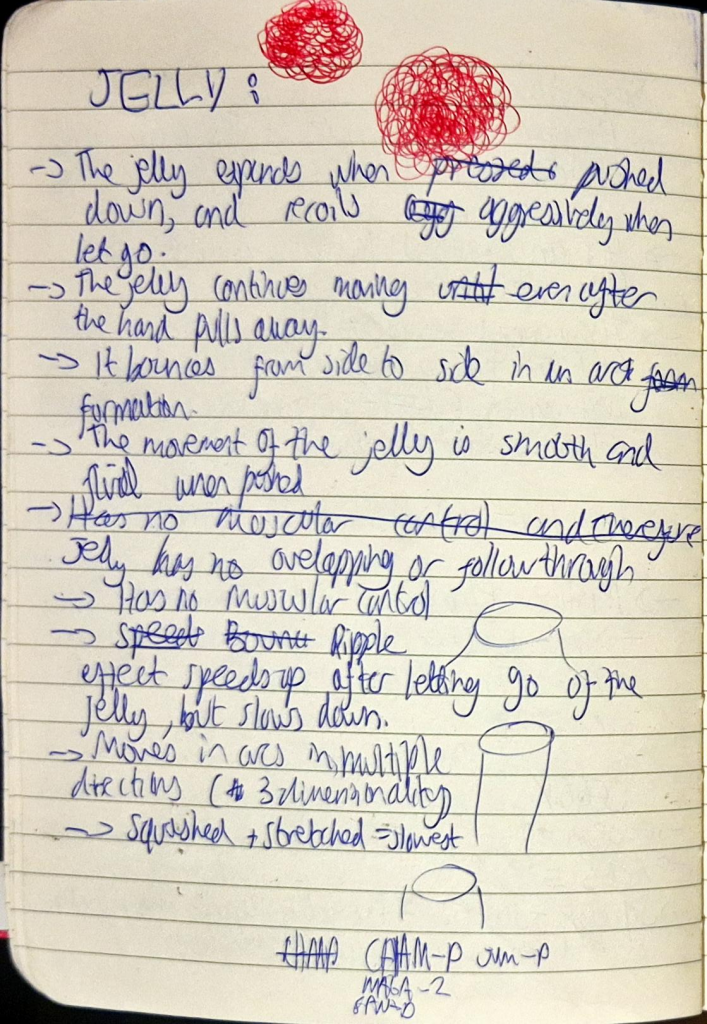
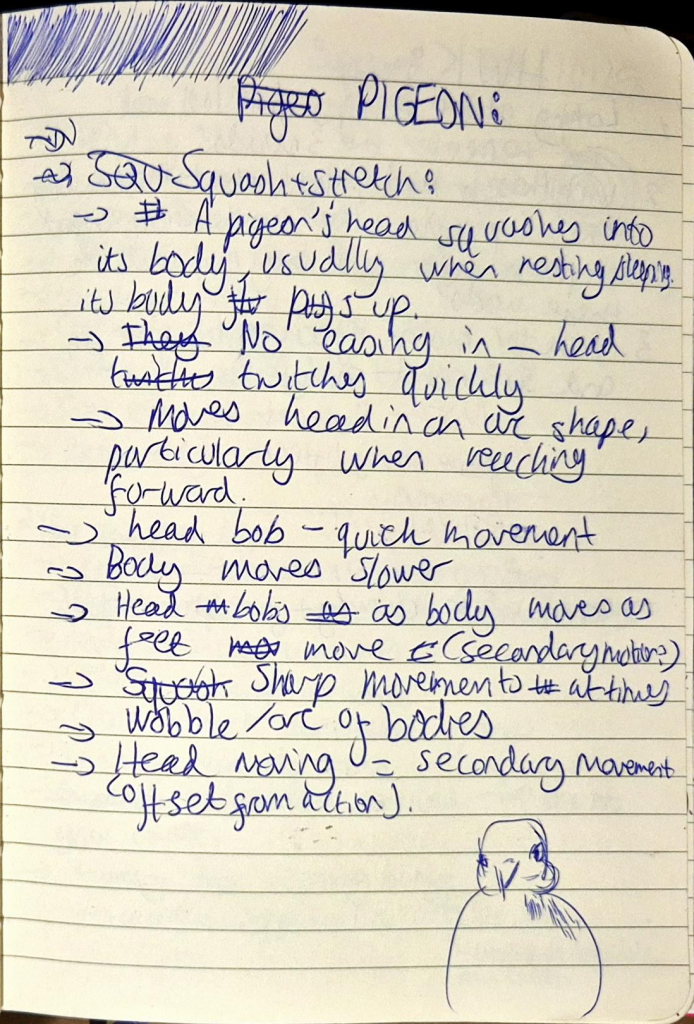
    Afterwards, we learnt about what motion plans were and how to apply the principles of animation that we were taught so far to examples shown. The intention behind the activity was to enhance how we explain the feeling of the movement to someone who has never seen the animation before (useful during a project/concept pitch) using the 12 principles of animation to do so. This activity was confusing at first as I didn’t understand what to write, and how to use the principles to explain how objects (in this case jelly) move. I did end up writing notes, as shown below (for both the jelly and pigeon examples):

    Jelly motion plan rough notes

    Pigeon motion plan rough notes

    For homework, we had to begin our motion plans and write about how the 6 principles that we’ve learned so far are implemented into the movement and behaviour of our respective characters, using motion references as visual evidence.

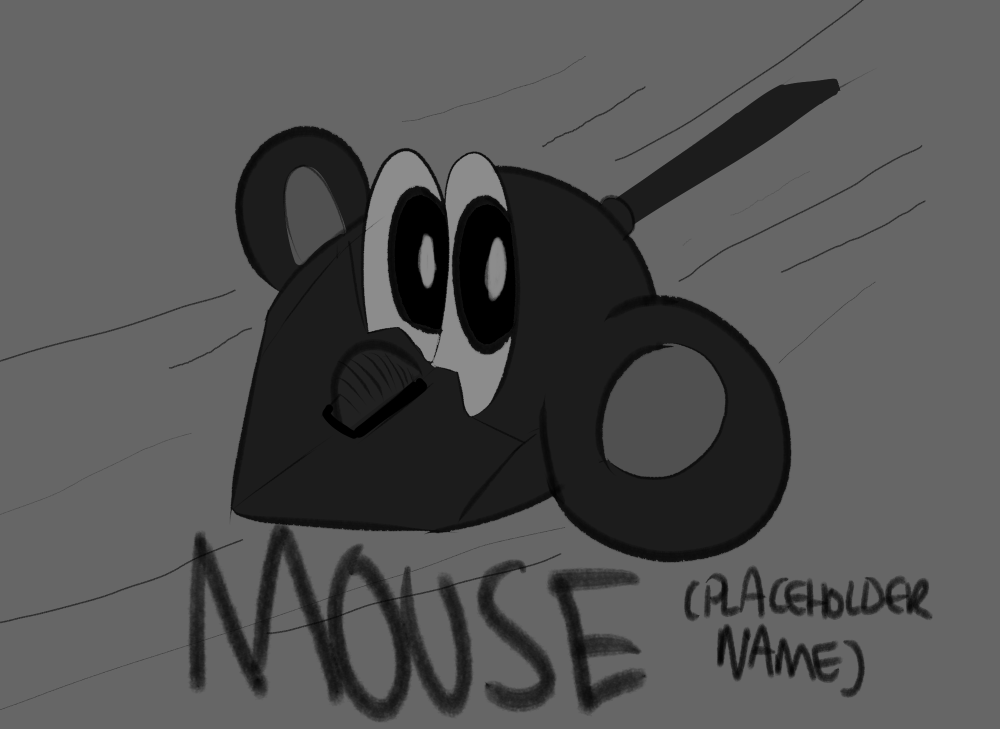
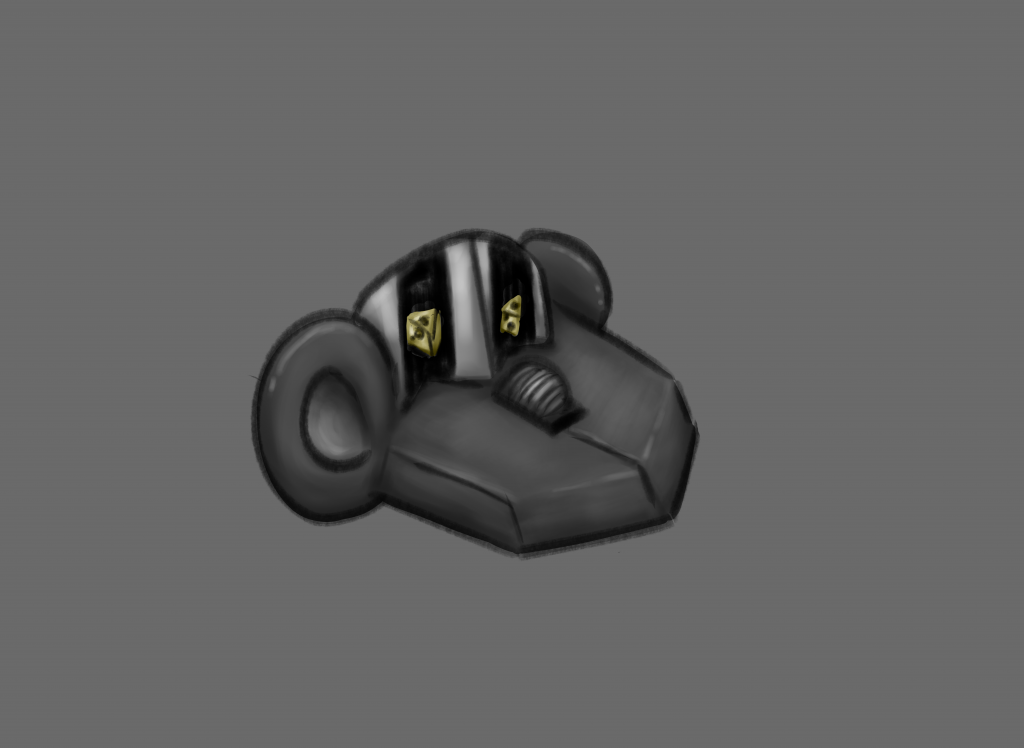
    In the meantime, I took one of Mouse’s designs from the character sheet I created and added colour to it to see how it would look. I didn’t use cel shading (It didn’t look good during my first attempt at colouring Mouse, which will be shown below), and ended up using the airbrush and soft eraser tools to create a softer look (that doesn’t detract from the overall materiality of Mouse).

    (Mouse using cel shading before redesign)

    (Mouse using typical soft shading)

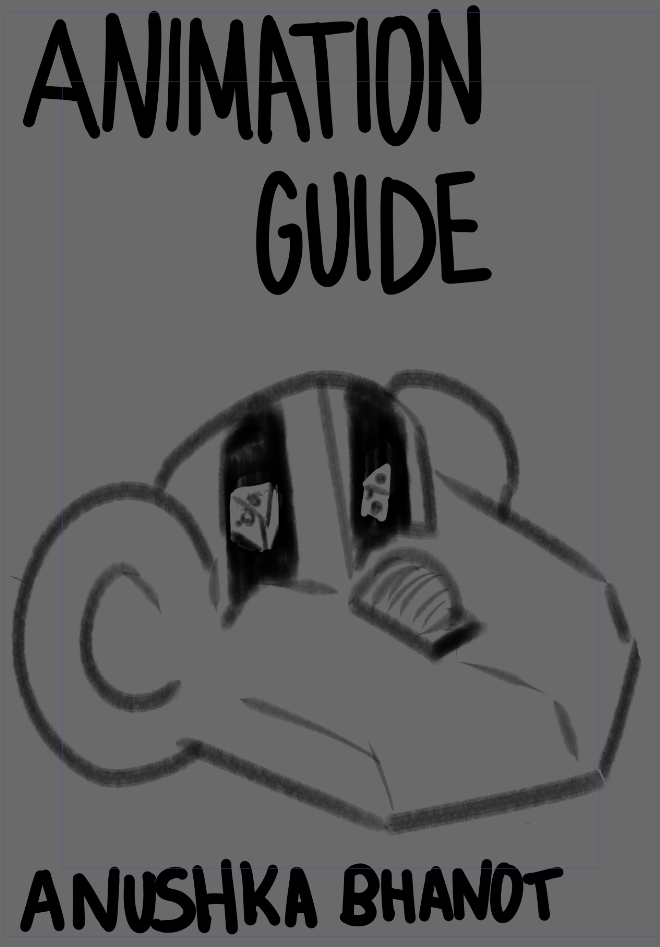
    I wanted to use Clip Studio Paint’s comicbook feature to write down my motion plan then copy and paste onto Google Slides, but it ended up taking a while to format so I stuck to just using Google Slides. These were the pages I made up until that point:

    Motion plan Clip Studio Paint