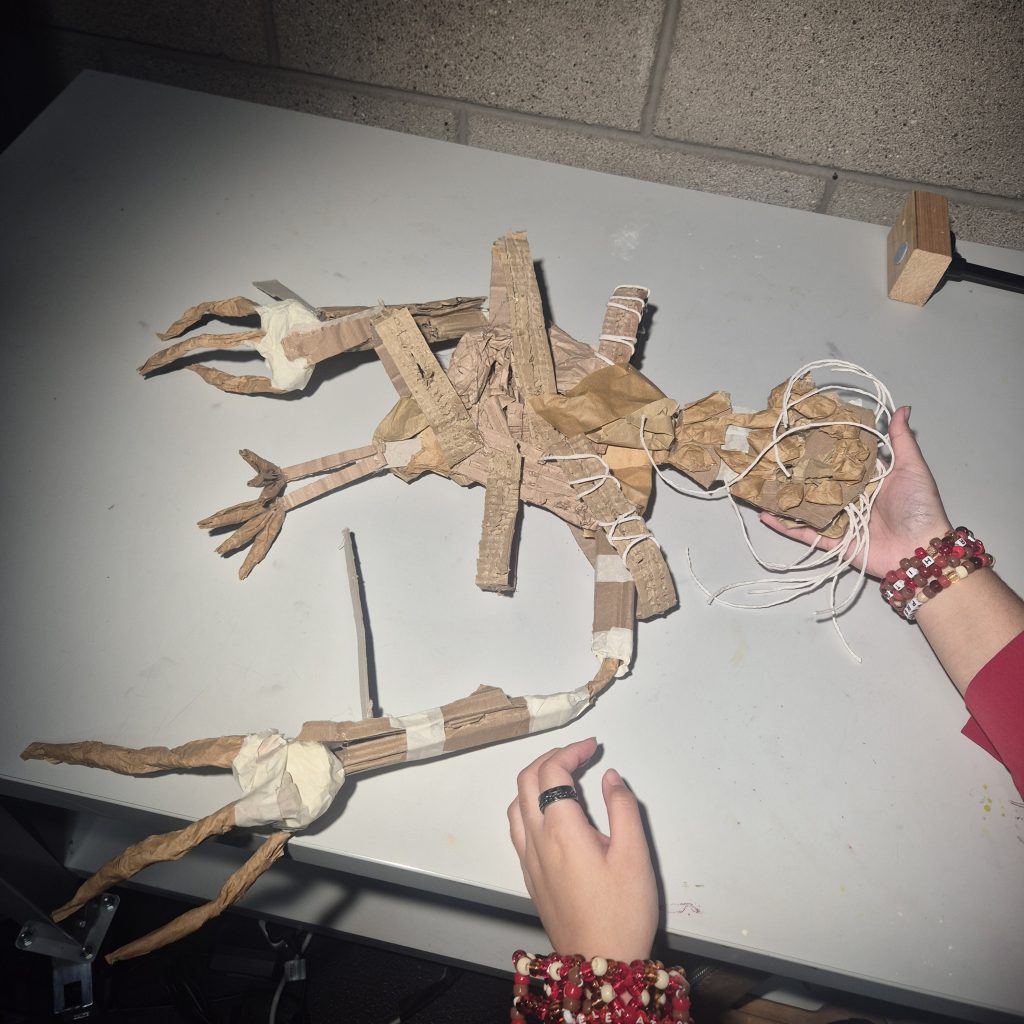
I fell sick on this day, therefore I wasn’t able to help my groupmates with animating our character. Instead, I worked on Intro to Animation.
Wednesday (19/11/25):
Thankfully by this time I felt better, so we continued working on where Joe and Lucian left off. Lucian wasn’t in, so Joe and I tried to complete the animation as efficiently as possible.
We were given feedback on the animation that we currently had. Chris told us that we weren’t necessarily making our character transform, and that it would be good if there was a more impactful transformation. Moreover, our hands acted too human-like, and so Chris suggested we use pixilation to make them move and act differently to what we actually perceive them as. So, Joe and I had the idea of making our hands act almost like snakes that begin to consume our character in an almost slapstick manner. We would show our hands eating the character’s body, then rip out some cardboard and make it seem like he’s being devoured.
However, while executing this idea our camera began glitching, displaying an error when a frame was taken. We’d then have to turn the camera off and on everytime we captured a few frames, then move it back into position as it would become askew. It was such a pain to endure, and set us back a lot. By the end of the lesson, we still hadn’t finished the animation.
Friday (21/11/25):
Lucian came back and we explained our situation, then used the time we had left to complete the animation. By this time, the camera suddenly began to work again, and so we quickly finished our animation, and Joe added the finishing touches such as sound (using predownloaded effects and foley) during the break.
Afterwards, we presented our work, which took some time as each group was given feedback. By that time, I felt so drained from completing the animation, so I wasn’t able to participate in conversation when prompted or listen to feedback properly.
PLEASE NOTE: Increasing the volume is advised for a better viewing experience.
Looking back at this rotation, while I did enjoy some aspects of stop motion animation, I don’t think it’s something that I want to pursue. If we instead used a different material such as clay or LEGO, I would have definitely reconsidered as I’m still not a fan of using cardboard. But overall, I’m happy with my group’s outcome and and how well we worked to create it.
When we started the stop motion rotation I was already quite worn out from the animatics rotation, and so I wasn’t looking forward to it as much as the Characterflux rotations. At the same time with this rotation I did have expectations that we got to choose the material we could work with, and so I was excited to try clay animation (polymer clay) as I love its texture and malleability (I also loved watching Timmy Time and Wallace and Gromit as a child).
Monday (10/11/25):
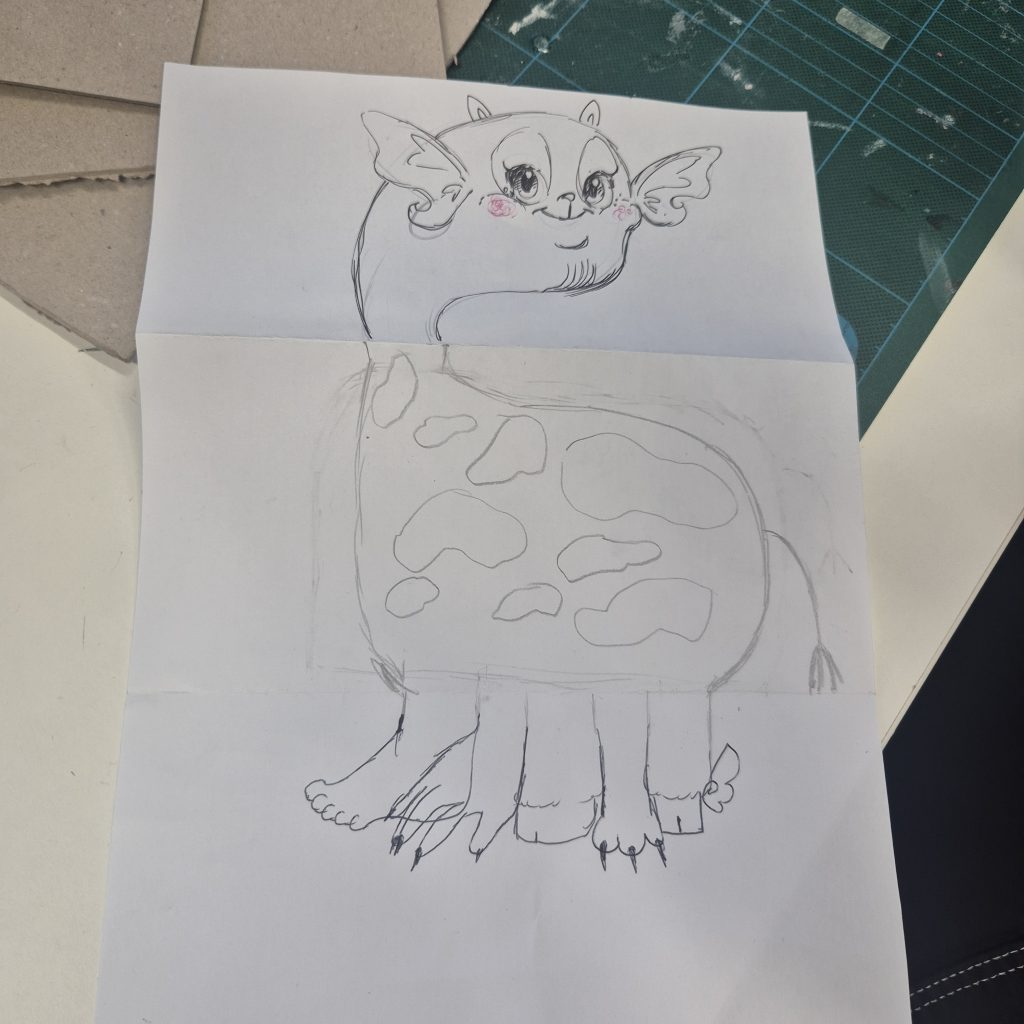
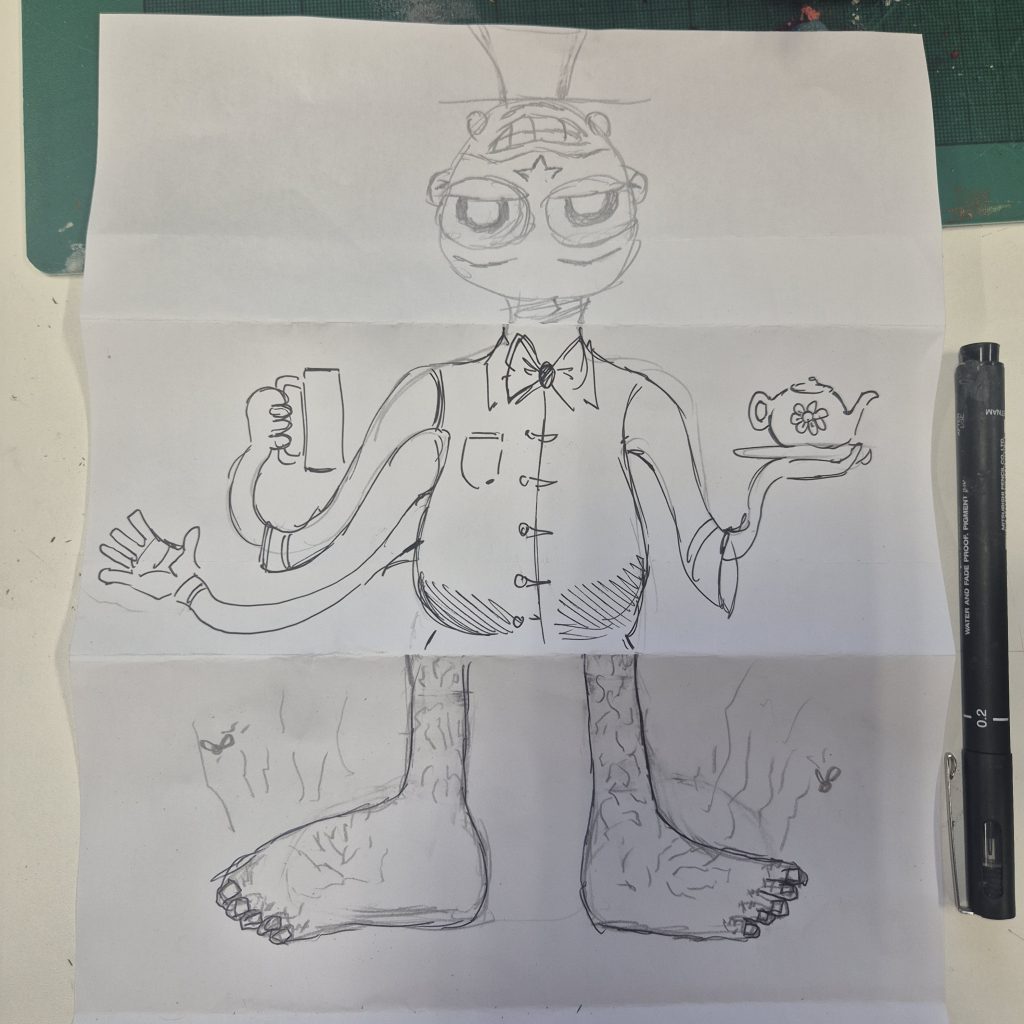
At the beginning of the lesson we were introduced to our tutor Chris, who gave us a warm-up activity to complete called exquisite corpse. This is a game where a person draws a part of the body without seeing what the person previously has drawn, before folding the paper and giving it to the next person. To elaborate:
Person 1 draws the head, folds the paper (adds guidelines in terms of where person 2 should draw from) then passes it to person 2.
Person 2 draws the body, folds the paper (adds guidelines in terms of where person 3 should draw from) then passes it to person 3.
Person 2 draws the legs, then the drawing is uncovered.
I drew the body.
I drew the legs.
This activity was extremely fun and helped me with teamwork and expanding my creativity, prompting me to think outside the box when drawing characters that are wackier than what I’d normally be accustomed to drawing.
After the activity, Chris explained to us what the rotation would consist of:
WEEK 1 (10/11/25-14/11/25):
Today: materiality
Wednesday: displacement animation – manipulation (puppets), tests, introduction to Dragonframe
To learn a new software to shoot stop motion sequences
Explore properties of materials through displacement + replacement animation,
And evaluate progress + outcomes both personally and amongst our peers.
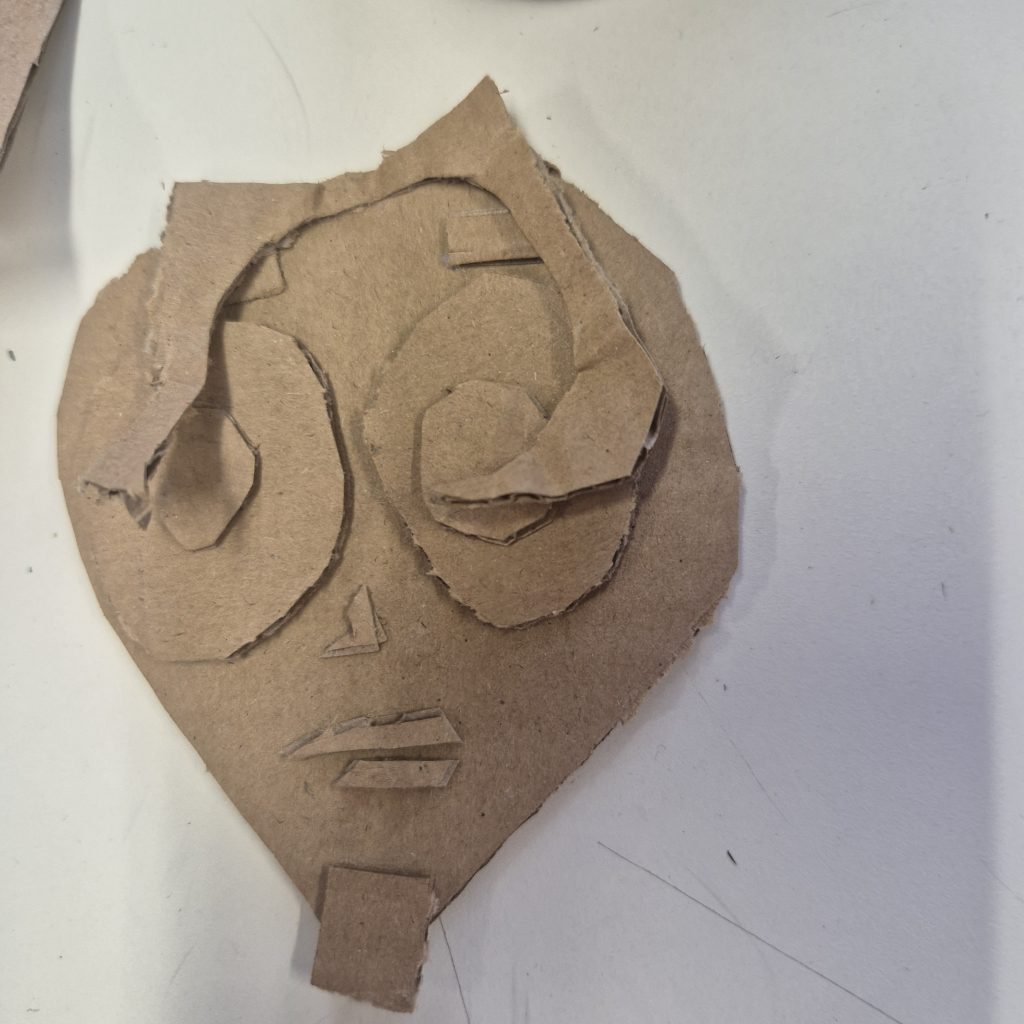
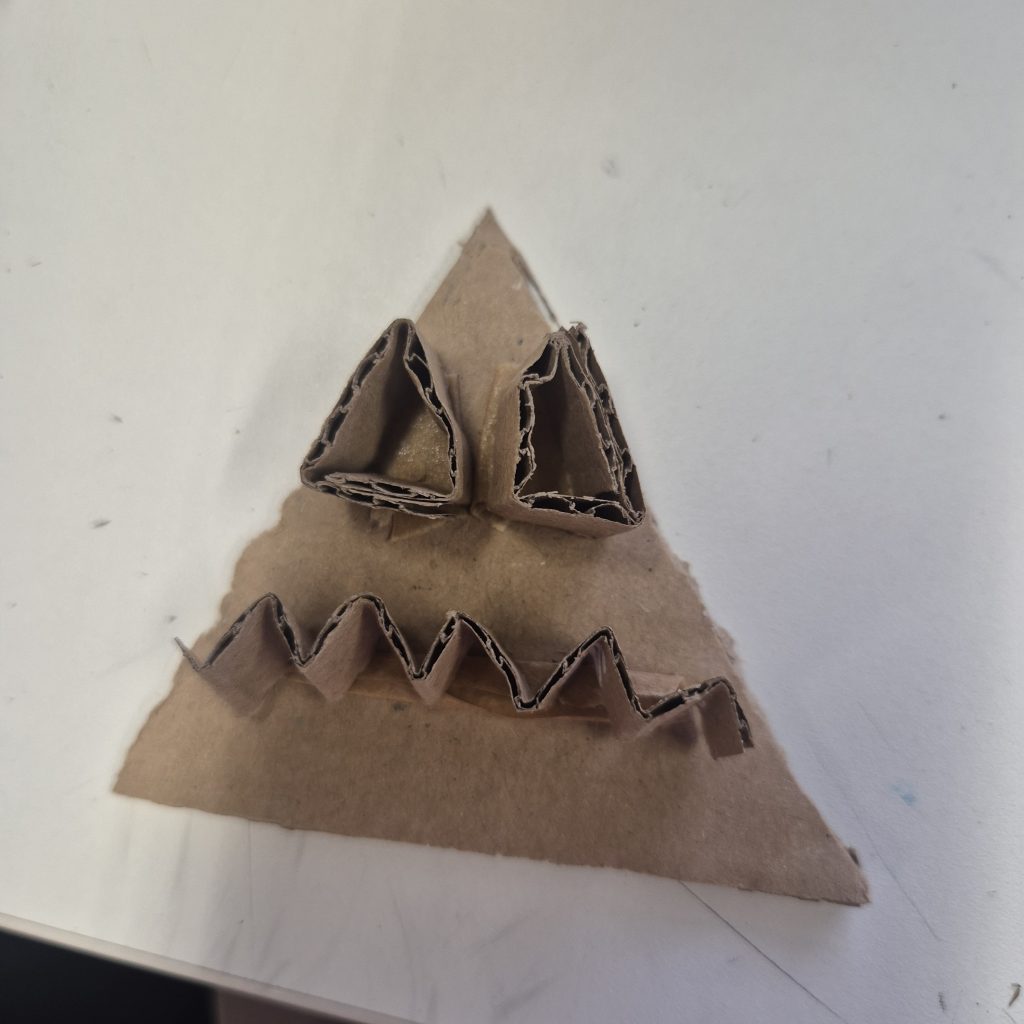
After watching the presentation, we learnt about the materiality of corrugated cardboard, and how it could be used to make puppets. We were then given another activity, which was to actually begin making small puppets out of cardboard inspired by the ‘Variations on the Human Face‘ by Bruno Manari. I didn’t realise they needed to be inspired by the artwork, and so I ended up making much simpler and sillier puppets than what was intended.
Overall, I’m not a fan of cardboard as a material when making puppets as it’s slightly limiting and not as easy to bend and stick at your will (and I was disappointed we weren’t working with clay). Although I would have probably enjoyed it more if I actually stuck to the brief.
Afterwards, we were put into small groups (I was in a group of 3) and given a task: to begin building a character that was around 30-50cm tall, which we would then use to animate using DragonFrame. My group members (Joe and Lucian) and I decided to make a sleep paralysis demon looking character with a terrifying face and body, but with small chicken feet to add a funny contrast. We didn’t finish creating our character, and from what I remember I finished making his toes (wrapping brown tape around my finger and compressing it) and sticking them together and onto a small piece of cardboard while Lucian and Joe worked on his body. Unfortunately, I didn’t take a photo of the character during this time.
I liked how quick the rotation was already becoming, and was looking forward to the rest of the sessions despite stop motion not being my strongest suit.
Wednesday (12/11/25):
On this day, we learned about displacement animation, more specifically pixilation. Pixilation is where live actors are used as the frame-by frame subject, essentially being reduced to puppets. As an example, we watched a stop animation by Jan Svankmeyer (one of my favourite animators) called Breakfast (Food 1992). The way Svankmeyer combined pixilation with real-time video was eerie but so fascinating, presenting one of the actors as a food dispenser, an inanimate object.
In our groups, we finished making our character, with Joe making the head and arms, Lucian making the body, while I finished making the head and spindly fingers. I used the same approach from when I made the chicken feet, wrapping up brown tape around my own finger until it was long enough, then compressing it and removing it. The main problem with this tactic was that sometimes the taped creation would get stuck, and so I would have to use scissors to pry it off my finger, a procedure that was quite unsafe and could have caused injury. Thankfully I left unscathed, and finished making all the fingers in the same fashion before handing them to Joe for him to stick onto the hand.
Our unnamed character.
Once we finished, we began making a practice stop motion animation using our character. We had the idea to use the set as a surgery table, and used pixilation for the movement of the light and our hands. I really loved the effect we used for the lighting, and how it slowly reveals our character.
We then made our creature sit up on its own, but found the movement was too fast despite animating on twos, and our hands were still visible, diminishing the effect of the creature coming to life. We ended up using it as our practice animation anyway, showing how we tried even if the outcome wasn’t what we had hoped.
Chris suggested we use black cloth and cover our hands, making sure we blend in with the black background. While we tried making another test and applied the feedback we received, they didn’t end up being very long as we had no time.
Friday (14/11/25):
We about replacement animation, more specifically transformation. In our groups, we were each given a shape and were told to change their forms and animate it on DragonFrame so that they morph into the next shape. My shape was a square, and I needed to modify it so that it morphed into Lucian’s shape, which was a triangle. This was a fun activity, although I wanted to prepare beforehand and so I used Stop Motion studio to make a test animation. Firstly I propped my phone onto my waterbottle, making sure the phone is placed so that it doesn’t suddenly fall. I then animated the square spinning into frame before being cut into a triangle (I used a Stanley knife for this and captured each frame of the square being torn). The video itself is unintentionally taken in portrait mode rather than landscape, and the first part of the animation is blurry, but I didn’t have the time to fix any of the mistakes before we went to the stop motion rooms to animate the real thing.
I’m glad I prepared beforehand because it helped me see whether I needed to change anything for the actual filming process on Dragonframe. However, I didn’t anticipate it taking so long, or for the shapes to be propped up on pins stuck to foam instead of laid out. Annoyingly, we do not have a copy of the stop motion shape animation, so it can’t be shown.
After a break, we began a new animation that would be the end of rotation project we’d work on until next Friday. We were told to apply the techniques of stop motion animation (pixilation and transformation) into our work, finding ways to implement it and show our character with humanlike qualities.